Can recycling thermoplastics help mitigate the impact of the energy crisis?
Impact of fluctuations in oil prices on the thermoplastics supply chain
Published by Luca Sazzini. .
Plastics and Elastomers Cost pass-throughIn the article: "Recycling Markets and Commodity Markets" the interactions between the scrap market, the recycled materials market, and the virgin commodity market were analyzed, highlighting how prices in the three markets tend to influence one another and remain closely linked to the price of the finished product. In particular, the more developed the recycling market is, the more closely scrap and recycled commodity prices are correlated with those of the respective final product. The strengthening of these price relationships can help mitigate sudden shocks affecting the costs of inputs required for the production of virgin commodities and their transmission to finished product prices. As production costs of virgin commodities increase, scrap materials tend to become relatively more convenient for producing finished goods, thereby exerting a stabilizing effect on final prices.
In this article, we analyze the strength of this mechanism in the thermoplastics market in order to verify whether recycling can at least partially mitigate the impact of oil price fluctuations on thermoplastics prices. The cracking of oil produces virgin naphtha, which represents the main feedstock for the production of virgin thermoplastics.
The analysis is structured in two parts. The first examines the evolution of oil and virgin naphtha prices following the blockage of the Strait of Hormuz. The second part analyzes long-term price elasticities along the supply chains of selected thermoplastics, with the objective of verifying whether the impact of oil and virgin naphtha prices can be partially absorbed by a highly developed recycling market.
Analysis of oil and virgin naphtha prices
The following chart shows the historical price series of oil and virgin naphtha from January 2020 to the present, expressed in euros per tonne.
As a benchmark for oil prices, the Brent financial price quoted on the Intercontinental Exchange (ICE) was used, converted into euros per tonne. For virgin naphtha, two distinct sources were considered. The first is the CFD (Contract for Difference) price provided by Trading Economics, reflecting the financial price traded on OTC, or over-the-counter, markets. The second source consists of European customs prices, which report the average values of import and export transactions recorded across the 27 EU member state customs authorities.
Historical series of oil and virgin naphtha prices, expressed in euros per tonne
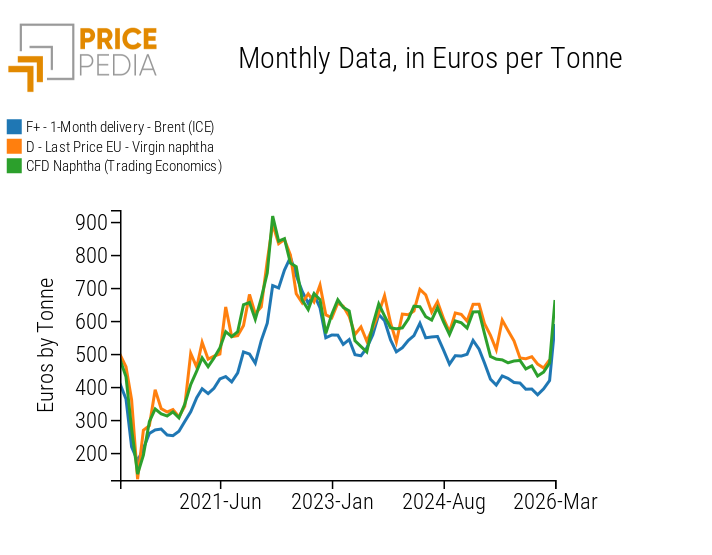
The chart analysis shows that the three prices tend to follow a common dynamic. Correlation coefficients are always above 0.9, on a theoretical maximum of 1, indicating that the prices of the two virgin naphtha series are very similar to each other, with a correlation of 0.97, and that both are closely linked to Brent price movements.
Due to the blockage of the Strait of Hormuz, the monthly average price from early March to today shows, for both Brent and the naphtha CFD price, a 40% increase compared with the February monthly average. This evidence indicates that the Brent price variation has been transmitted almost entirely to virgin naphtha prices. It is therefore useful to verify whether such a strong transmission also propagates along the rest of the production chain, influencing plastic prices to a similar extent.
Impacts on plastic prices
The following map reports the long-term elasticities along the supply chains of three thermoplastics: PET, polyethylene, and polypropylene.
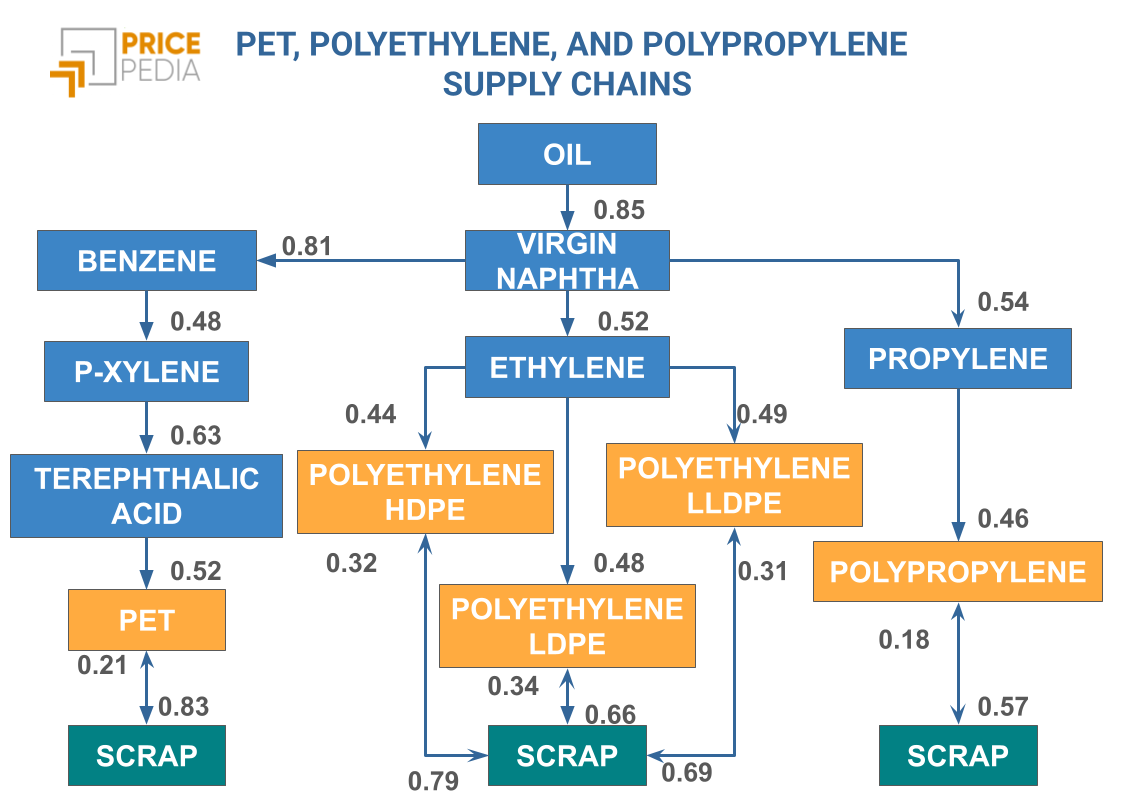
The flowchart analysis highlights the long-term elasticities between the prices of the different products considered. The elasticity between oil prices and virgin naphtha prices is equal to 0.85, meaning that, all else being equal, a 10% increase or decrease in oil prices leads on average to an 8.5% increase or reduction in naphtha prices.
Despite the high elasticity between oil and naphtha, the elasticity between oil and polymers is much more limited. For example, the elasticity between oil prices and PET prices is relatively low, equal to 0.11, a value obtained as the product of elasticities along the supply chain, namely 0.85 × 0.81 × 0.48 × 0.63 × 0.52. This elasticity is approximately half of that estimated between the price of PET production scrap and the price of PET itself, which is equal to 0.21. It should nevertheless be considered that scrap prices are themselves influenced by polymer prices, which slightly increases the overall elasticity of polymer prices with respect to oil price variations through this indirect channel.
A similar pattern emerges for different types of polyethylene, where the elasticity between oil prices and final product prices is always lower than the elasticity observed between scrap and polymers. An exception is represented by polypropylene, for which the elasticity between oil and polypropylene prices, equal to 0.21, is slightly higher than the elasticity between scrap prices and polypropylene prices, equal to 0.18.
Overall, all else being equal, an increase in oil prices translates on average into relatively limited increases in the prices of the various polymers, with a maximum elasticity of 0.21. These impacts are consistent with the presence of a highly developed recycling market, which tends to contain polymer price fluctuations. When oil prices rise significantly, recycled polymers become more convenient than virgin ones, shifting part of demand from virgin polymers to recycled materials and consequently influencing relative prices.
Conclusions
This analysis shows that, all else being equal, increases in oil prices tend to be transmitted significantly to the final prices of virgin polymers, although the effect is partially mitigated by the presence of a competing recycled polymer market. The results obtained using dynamically specified econometric models are consistent with the existence of a highly developed recycling market that closely links scrap prices to polymer prices.
When the costs of inputs required for the production of virgin commodities increase significantly, firms tend to expand demand for recycled polymers in order to contain production cost increases, with the effect of limiting the overall impact of oil price variations on final polymer prices.
You may be interested in:

Plastics and Elastomers: China's Market Plays an Increasingly Key Role
Published by Luigi Bidoia. .
Plastics and Elastomers Price DriversLa pressione competitiva della Cina contribuisce a influenzare i prezzi in Europa [ Read all ]
Anti-dumping measures against China: the case of PET
Published by Pasquale Marzano. .
Plastics and Elastomers basic thermoplastics Polyethylene terephthalate (PET) Import tariffsThe Commission's Procedure against low-cost Chinese PET [ Read all ]
Update of non-energy hydrocarbon prices to May 2024
Published by Luca Sazzini. .
Organic Chemicals Plastics and Elastomers Price DriversIs the hydrocarbons market global or regional? [ Read all ]