The impact of tensions in the Middle East on energy and metal prices
Expectations of less accommodative monetary policy are holding back the rise in metal prices
Published by Luca Sazzini. .
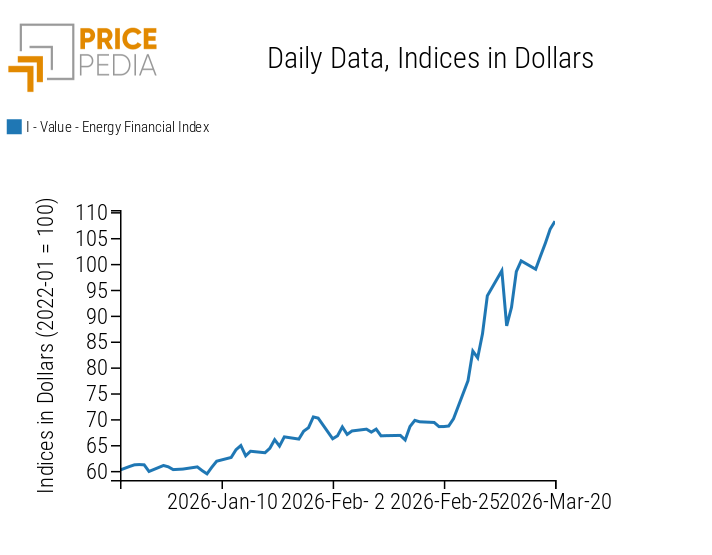
Conjunctural Indicators Commodities Financial WeekThe increase in supply risks, linked to the intensification of attacks against energy infrastructure in the Persian Gulf, is exerting strong upward pressure on financial energy prices, while simultaneously increasing their volatility.
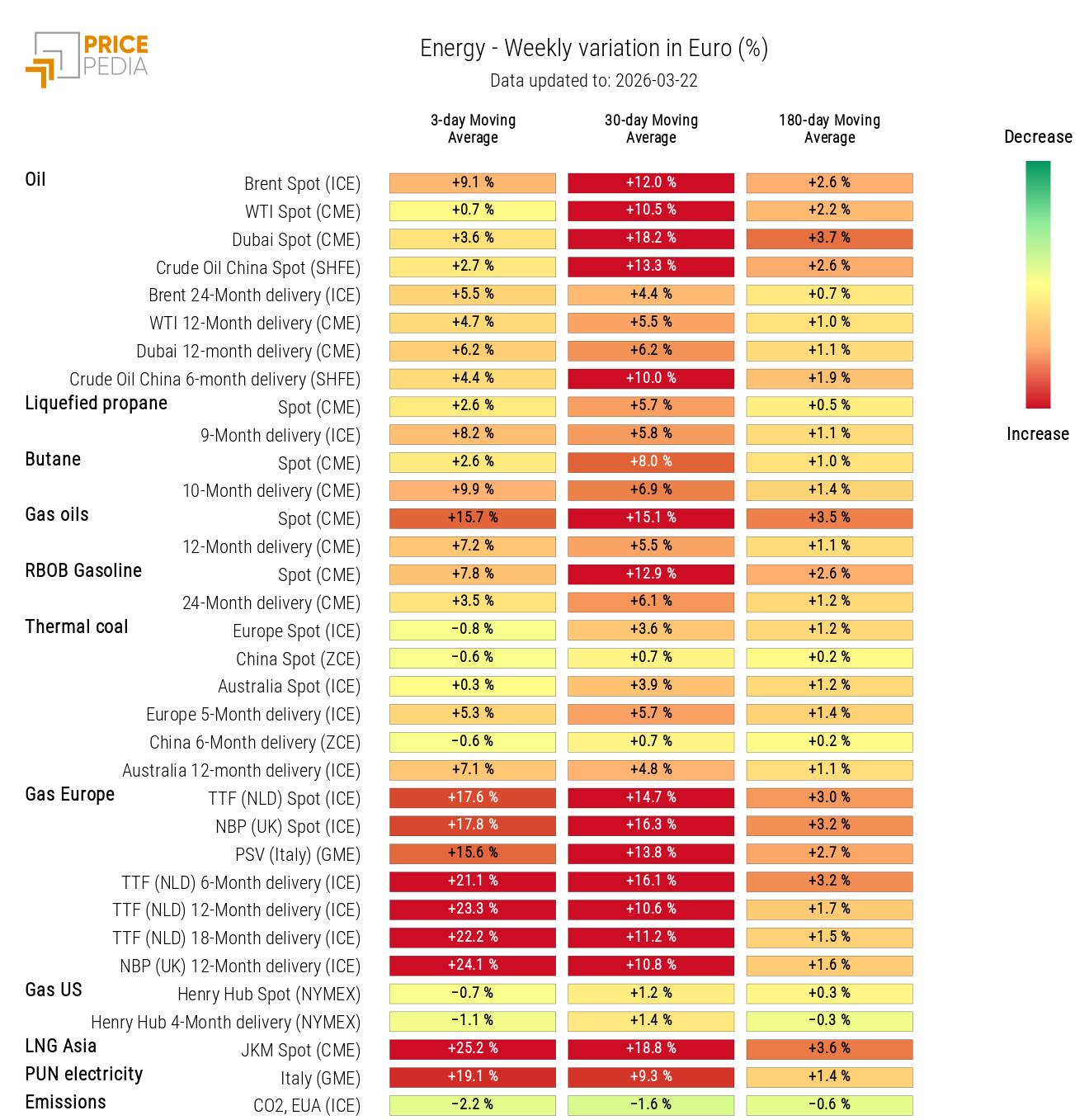
On a weekly basis, Brent prices rose by 9%, reaching $112 per barrel and recording intraday price swings of up to $50 per barrel. For example, on Thursday, prices had temporarily fallen back to around $70 per barrel, supported by expectations of possible suspensions of U.S. sanctions on Iran and by joint diplomatic initiatives by the U.S., European countries, Japan, and Canada aimed at ensuring safe passage for ships through the Strait of Hormuz. However, following the announcement of damage sustained in Ras Laffan, Qatar, home to refineries, petrochemical plants, and the world’s largest LNG export terminal, Brent prices peaked at $120 per barrel, closing the day at around $109 per barrel.
In the European natural gas market, the impact of the Middle East escalation was even more pronounced, with the price of TTF Netherlands reaching €60/MWh.
QatarEnergy authorities confirmed that Iranian attacks reduced approximately 17% of the company’s LNG export capacity, damaging two of the 14 liquefaction “trains” and one of the main gas-to-liquids (GTL) facilities. As a result, force majeure was declared on several long-term contracts with importers in Europe and Asia, with repairs estimated to require 3-5 years for completion. The market therefore began pricing in not only a temporary supply disruption but also the risk of a structural reduction in Qatari LNG availability. The situation is particularly relevant for Europe, where Qatar, following the war in Ukraine, had been becoming the main LNG supplier after the United States, gradually replacing supplies previously imported from Russia.
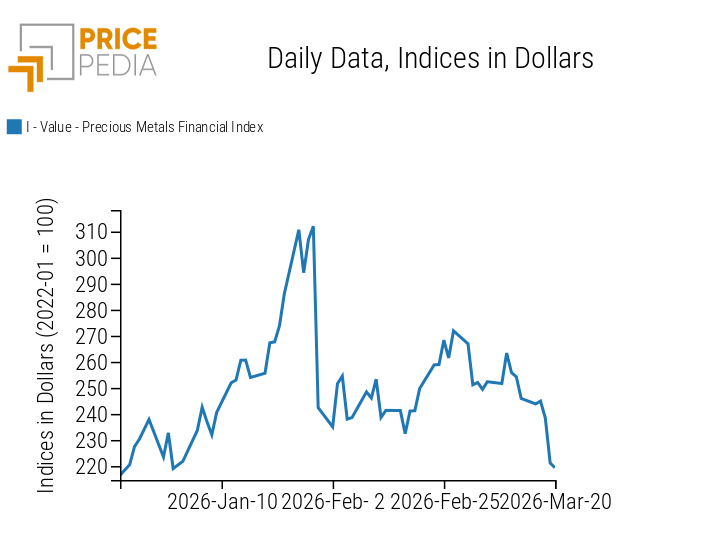
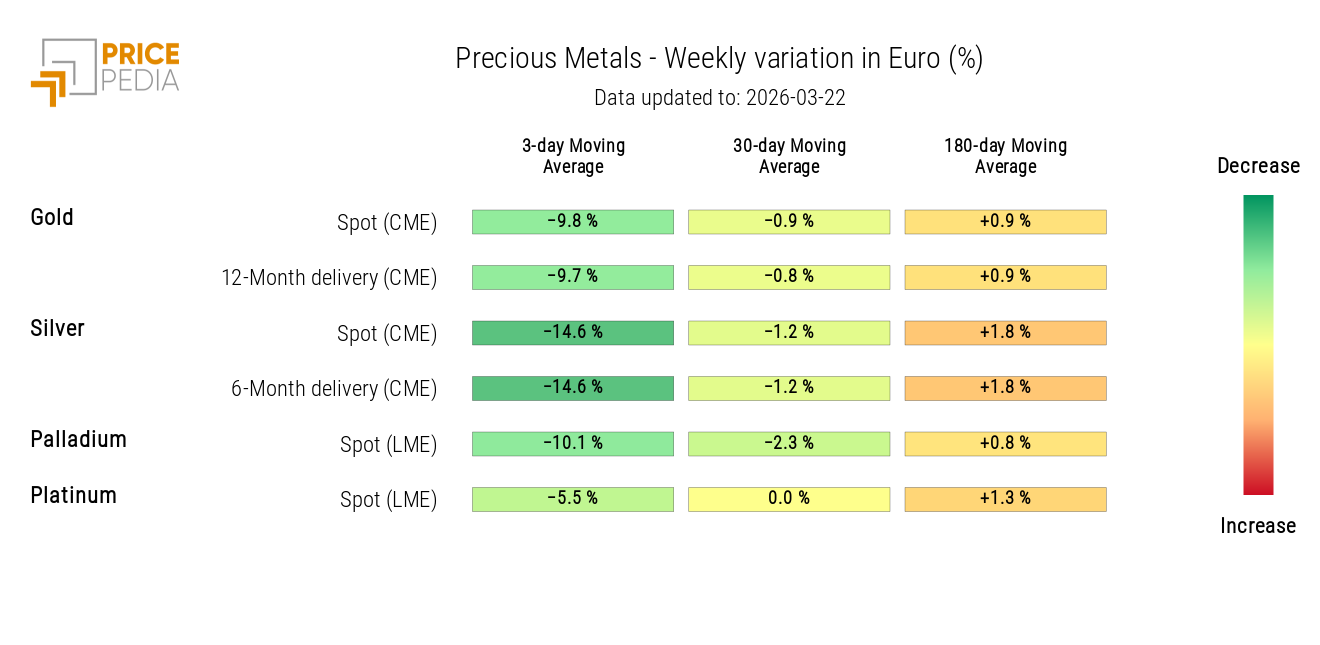
While rising geopolitical tensions pushed energy prices higher, the same did not occur for precious metals, which recorded a downward trend. Investors are increasingly favoring oil as a safe-haven asset, taking profits on gold and silver amid fears of tighter monetary policies linked to expectations of higher inflation driven by rising energy prices. In particular, gold and silver prices returned to levels of $4500 and $70 per ounce respectively, with weekly changes of -10% and -14%.
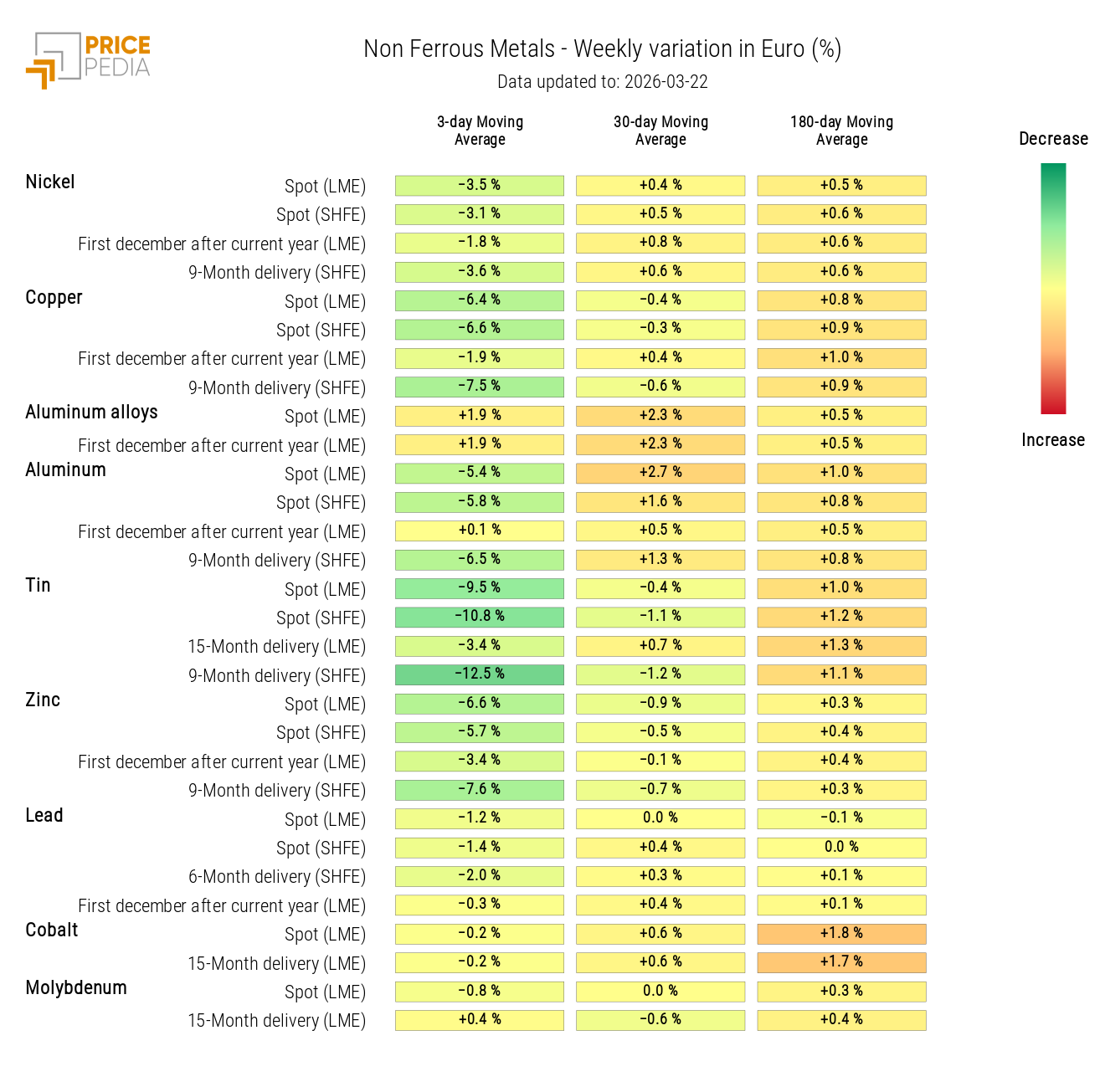
In the industrial metals sector, ferrous metals remained broadly stable, while non-ferrous metals recorded declines even greater than those of precious metals. Among the latter, a generalized reduction in major base metals was observed, driven not only by expectations of tighter monetary policies but also by rising inventories, slowing Chinese demand, and prospects of a potential global recession.
Even LME aluminum prices, supported by the disruption in the Strait of Hormuz, through which about 10% of global supply transits, recorded a weekly decline of -5%.
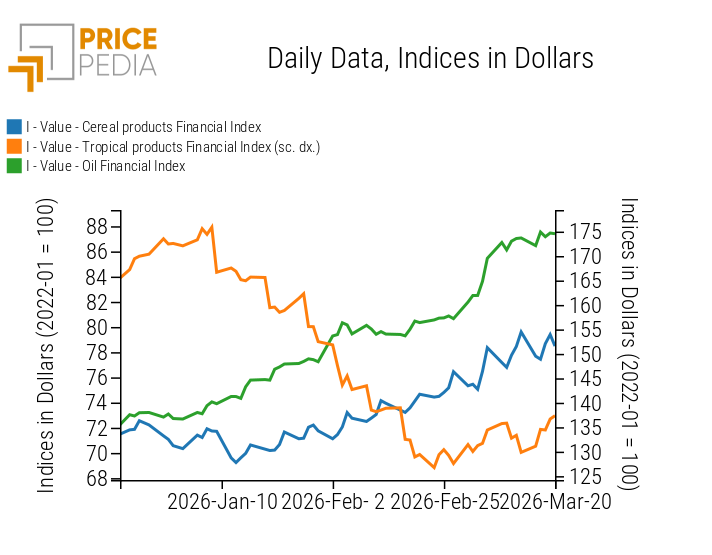
As for food commodities, prices of cereals and edible oils remained broadly stable, while tropical commodities showed a partial recovery following recent declines.
Monetary Policies
Federal Reserve
The March FOMC meeting confirmed rates unchanged within the 3.50-3.75% range, with a single dissenting vote in favor of a cut. The main novelty in the statement was the explicit reference to the Middle East war as a new source of uncertainty, acknowledging potential effects on both energy prices and domestic demand and employment.
The new Summary of Economic Projections revised both inflation and growth estimates upward, while confirming that inflationary increases linked to tariffs and the energy shock are considered temporary. Forecasts still indicate the possibility of rate cuts in 2026 and 2027, but most Fed members believe any reduction is likely only toward the end of the year. The tone of the press conference confirms a Fed in a wait-and-see mode, though attentive to the deterioration of the outlook following the Middle East war.
European Central Bank
The European Central Bank kept policy rates unchanged, confirming a data-dependent approach with decisions taken meeting by meeting.
The energy shock linked to the war in the Persian Gulf has increased uncertainty, with short-term inflationary effects and potential repercussions on growth. Updated staff projections show higher inflation across the entire forecast horizon, while GDP growth estimates were revised downward. In this scenario, the ECB maintains a cautious stance, while acknowledging that the persistence of the inflation shock could justify a 25-basis-point rate increase between June and July. Markets are already pricing in a total increase of about 65 basis points by year-end, highlighting increased attention to energy price dynamics and their transmission to non-energy goods prices.
NUMERICAL APPENDIX
ENERGY
The PricePedia financial index for energy products continues its price growth driven by the Middle East escalation.
PricePedia Financial Index of Energy Prices in Dollars
The energy heatmap highlights significant weekly increases in energy prices, particularly for natural gas.
HeatMap of Energy Prices in Euros
PRECIOUS METALS
The financial index for precious metals shows a weekly decline in prices.
PricePedia Financial Index of Precious Metals Prices in Dollars
Heatmap analysis shows a generalized decline in precious metal prices, particularly silver.
HeatMap of Precious Metals Prices in Euros
FERROUS METALS
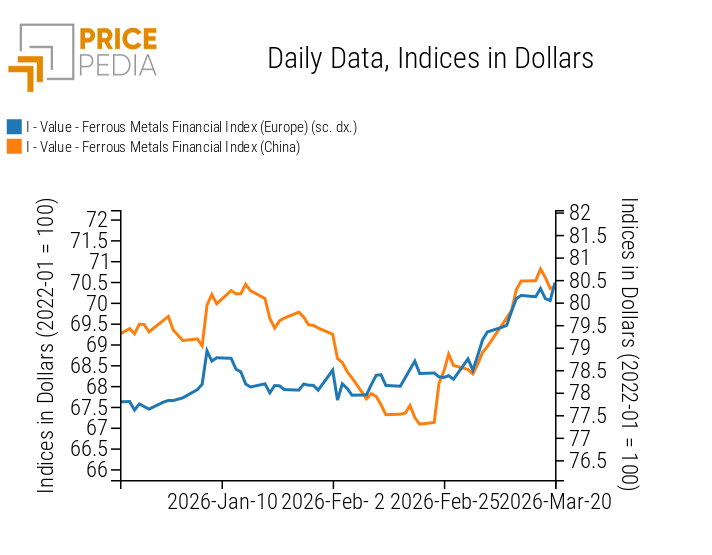
The two financial indices for ferrous metals show mostly sideways weekly dynamics.
PricePedia Financial Indices of Ferrous Metal Prices in Dollars
Do you want to stay up-to-date on commodity market trends?
Sign up for PricePedia newsletter: it's free!
INDUSTRIAL NON-FERROUS METALS
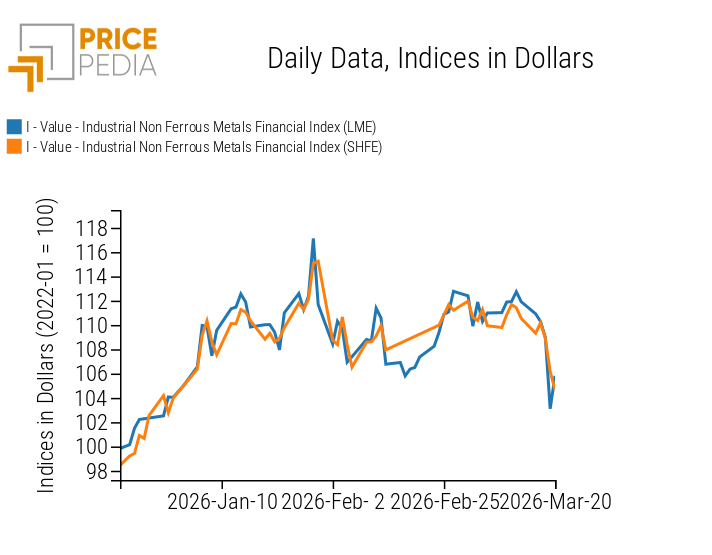
Both financial indices for non-ferrous metals recorded a decline in prices.
PricePedia Financial Indices of Industrial Non-Ferrous Metal Prices in Dollars
Heatmap analysis of non-ferrous metals highlights a generalized decline among the main base metals.
HeatMap of Non-Ferrous Metal Prices in Euros
FOOD COMMODITIES
Financial indices for grains and edible oils stabilized, while tropical commodities recorded a partial price recovery.
PricePedia Financial Indices of Food Commodity Prices in Dollars
CEREALS
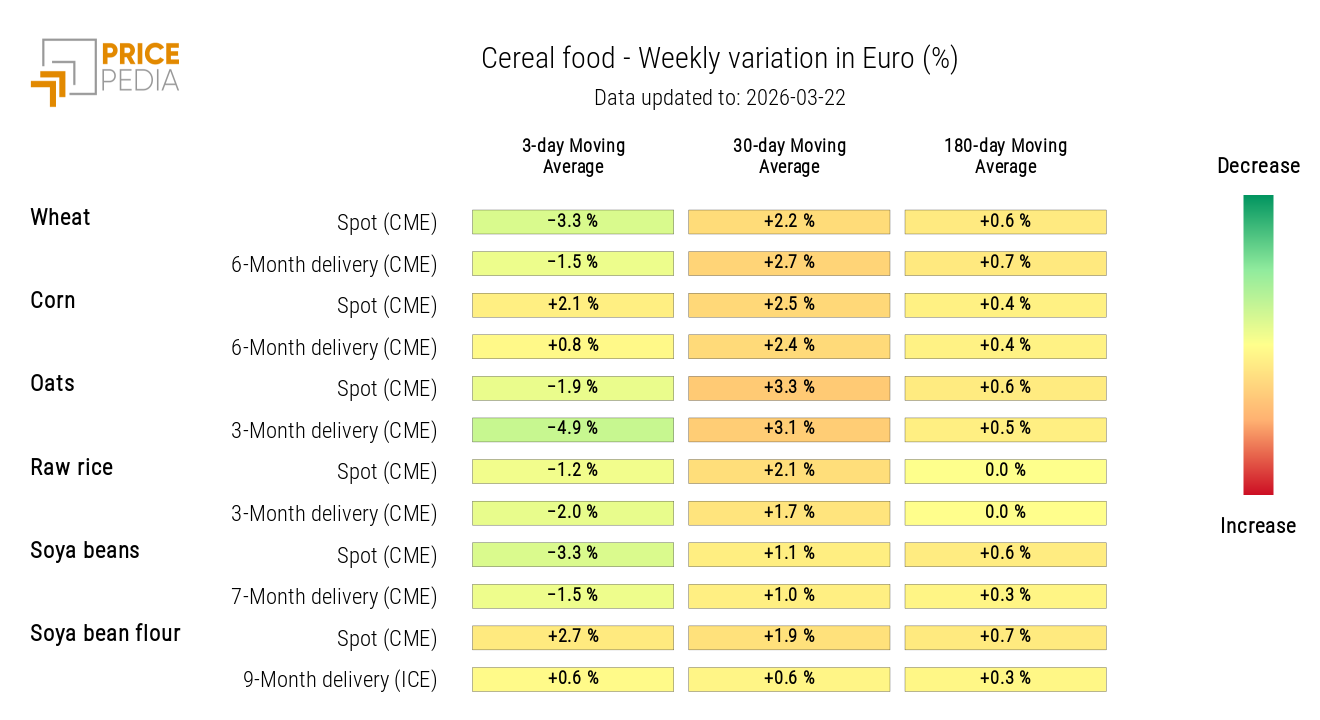
The cereal heatmap shows weekly price increases for corn, alongside a decline in soybean prices.
HeatMap of Cereal Prices in Euros
TROPICAL COMMODITIES
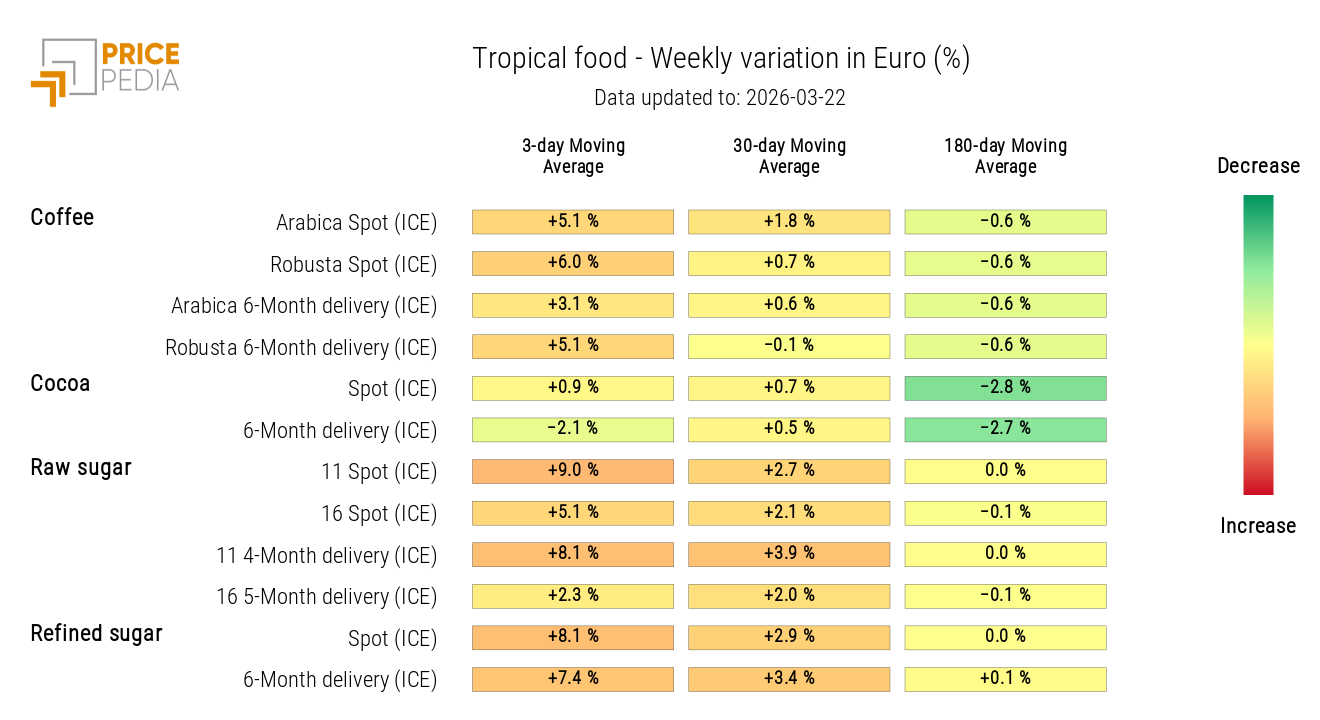
The tropical commodities heatmap signals a generalized price recovery, especially for sugar.
HeatMap of Tropical Food Commodity Prices in Euros
OILS
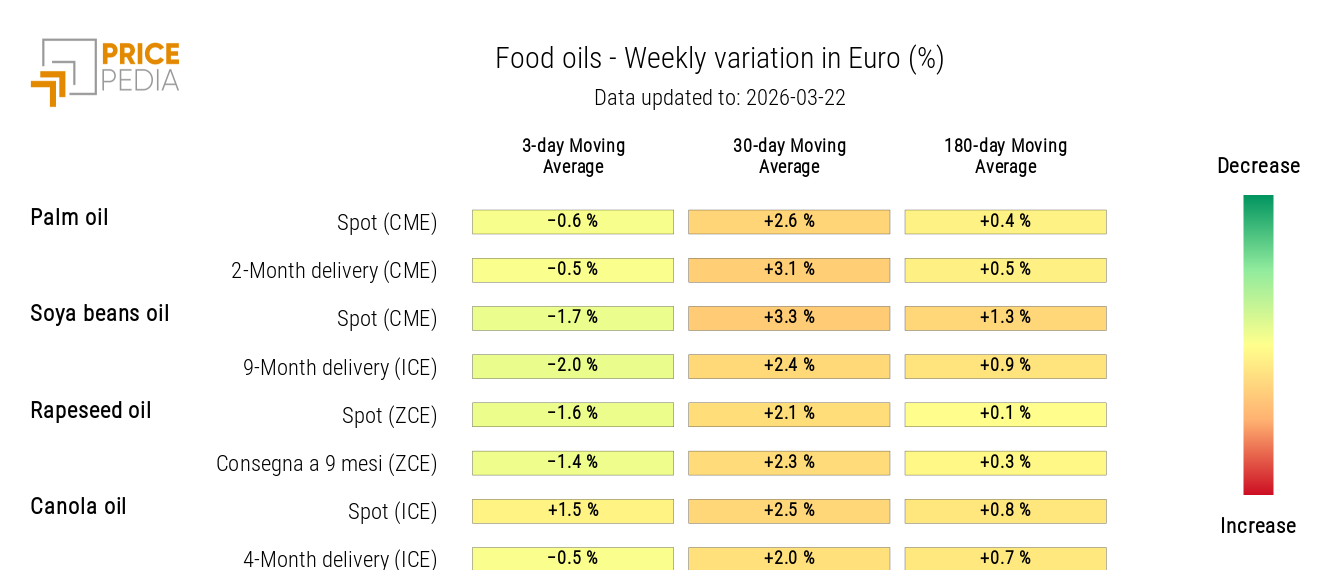
The edible oils heatmap highlights a weekly decline in soybean oil prices.
HeatMap of Edible Oil Prices in Euros
You may be interested in:
Commodity prices at the mercy of the conflict in the Middle East
Published by Luca Sazzini. .
Conjunctural Indicators Commodities Financial WeekThe announcement of the IEA's additional supply is not enough to curb oil prices [ Read all ]

Effects of the conflict in Iran on financial commodity prices
Published by Luca Sazzini. .
Conjunctural Indicators Commodities Financial WeekCommodity prices under pressure due to the blockade of the Strait of Hormuz [ Read all ]
Commodity markets under pressure amid geopolitical risks and trade uncertainties
Published by Luca Sazzini. .
Conjunctural Indicators Commodities Financial WeekFinancial prices of metals resume their upward trend [ Read all ]