The direct effects of Natural Gas on procurement materials
Which products are most exposed to recent fluctuations in energy inputs?
Published by Pasquale Marzano. .
Strumenti Natural Gas Analysis tools and methodologies
The ongoing conflict in the Persian Gulf is exerting strong pressure on international oil and natural gas prices. Around 20% of global trade in these two energy commodities passes through the Strait of Hormuz, a strategic chokepoint for global hydrocarbon flows. Rising tensions in the region and the reduction in maritime traffic observed in recent weeks (see the graph below, source IMF PortWatch) have increased the perceived risk of supply disruptions, supporting energy prices on international markets.
In this context, Brent crude oil, the main global benchmark, has fluctuated around 100 dollars per barrel, while natural gas prices have recorded overall increases of approximately +50% since the onset of hostilities.
Strait of Hormuz: tanker ships flows
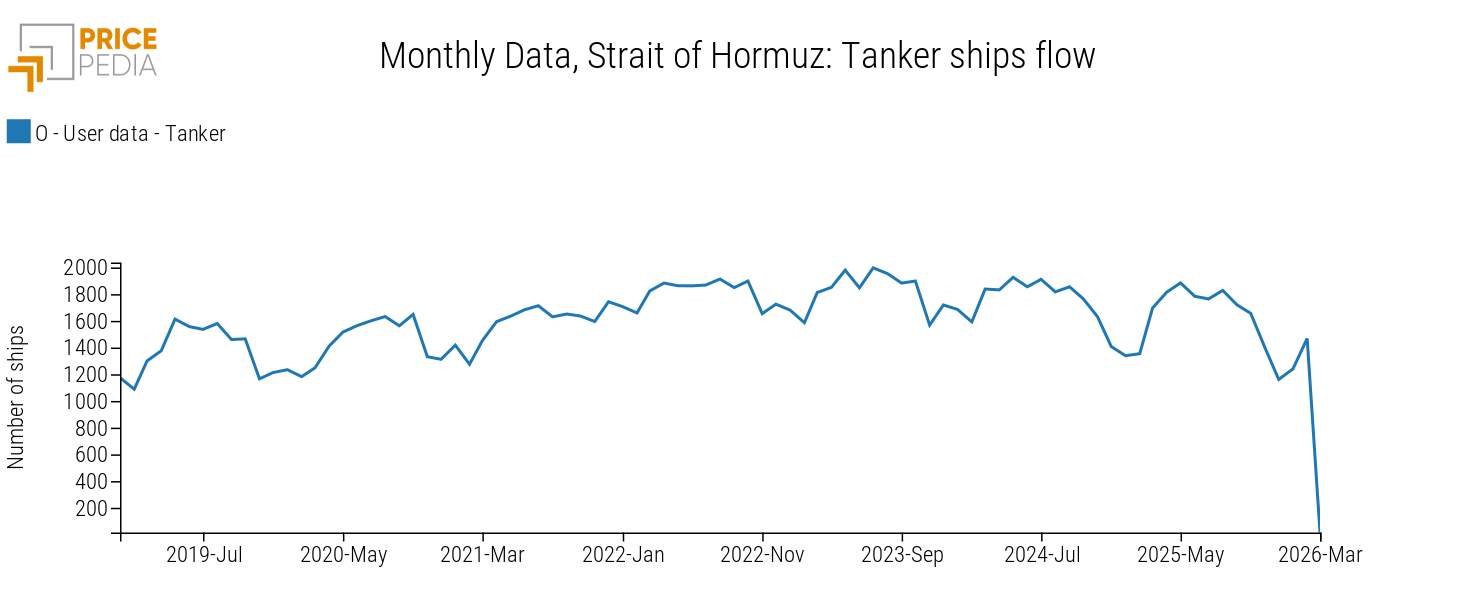
The increase in natural gas prices has affected both Asia and Europe relatively broadly, despite the fact that most liquefied natural gas (LNG) passing through the Strait of Hormuz is destined for Asian markets. In 2025, only 9% of European LNG imports originated from the Persian Gulf, particularly from Qatar, the region's leading LNG exporter.
This transmission of price shocks across geographical areas reflects the growing degree of integration of global natural gas markets. This integration has strengthened especially since 2022, when Europe, following Russia's invasion of Ukraine, began progressively replacing Russian gas supplies with increased LNG imports from various partner countries, including the United States. This process has intensified the interconnection between regional gas markets, as discussed in the article Global gas market: towards new equilibria.
The chart below compares the price of TTF natural gas, expressed in euros per MWh, with the JKM LNG price, expressed in euros per MMBtu (right axis).
International Natural Gas Prices: TTF vs. JKM
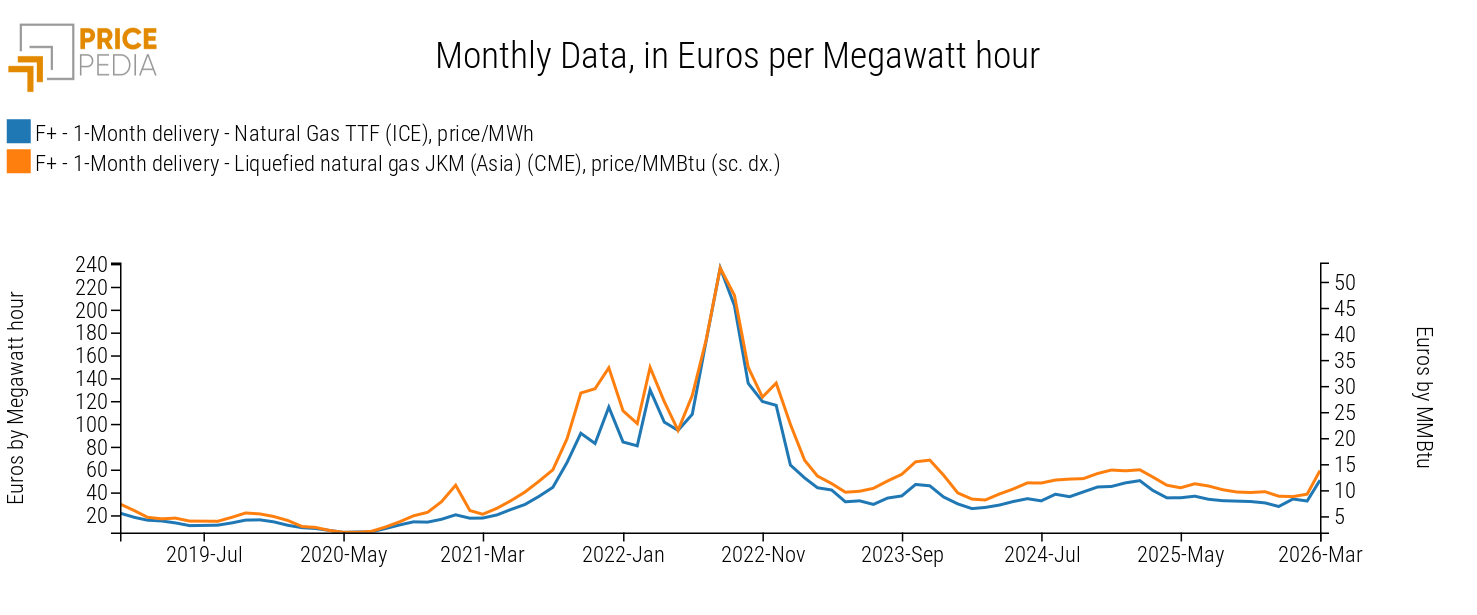
The chart highlights the strong correlation between prices in the two regions, which follow a similar pattern.
While Europe's supply diversification strategy has significantly reduced dependence on Russian gas, it has also made the European market more exposed to competition with Asia for LNG procurement and to global market shocks.
Do you want to stay up-to-date on commodity market trends?
Sign up for PricePedia newsletter: it's free!
A measure of the direct effect of Natural Gas on procurement materials
Given the central role of natural gas in European manufacturing and the volatility observed in its prices, it is useful to define a measure of the direct sensitivity of industrial input prices to increases in natural gas prices. This allows for an assessment of the exposure of different products to fossil fuel dynamics. Direct effects represent only part of the overall impact of gas price increases, but they are the main driver of differentiation across commodities.
The measure used to quantify these effects is the long-term price elasticity of the product with respect to gas, defined as the percentage change in the material price that, in the long run, is directly associated with a percentage change in the price of the fuel.
For example, an elasticity of 0.4 implies that, ceteris paribus, a 50% increase in natural gas prices is associated, in the long term, with an approximately 20% increase in the price of the product considered.
The table below reports the products for which natural gas has been found to be statistically significant in directly determining their price, within the PricePedia project aimed at building a structural model of European commodity prices.
| Long-term elasticity | Products |
|---|---|
| High (> 0.7) | Electricity Italy, Anhydrous ammonia |
| Medium-high (0.25-0.7) | Alkaline-earth metal compounds, Ground natural calcium phosphates, Acetic acid |
| Moderate (0.10-0.24) | Float glass, Caustic soda (liquid), Sulfuric acid and sulfates, Caustic potash, Methanol, Methylene chloride, Organic acids, Polycarbonates (PC), P-xylene, O-xylene, Organic anhydrides, Semimetal compounds, Cationic surfactants, Butene, Polyurethanes, Liquefied propane (purity ≥ 99%), Non-ionic surfactants |
| Low (< 0.1) | Amphoteric surfactants, Alcohols, Propylene, Phthalic anhydride, Nitrogen compounds, Liquefied propane (purity 90 - 99%), Liquefied butanes (purity ≤ 90%), Kraftliner (weight ≥ 150 g/m2 and ≤ 175 g/m2), Anionic surfactants, Metal compounds, Ethylene oxide, Testliner, Aluminum sulfates, Copper sulfates, Bottle glass |
In the case of electricity, elasticity approaches 0.8, consistent with the role of gas-fired power plants in setting the marginal price of electricity.
Given the importance of electricity in industrial production processes, the indirect effects of this relationship are therefore widespread.
The high elasticity of ammonia is also particularly relevant, as this raw material is at the core of the fertilizer value chain, amplifying the transmission of energy shocks to agricultural markets.
For many basic chemicals such as acetic acid, caustic soda, and methanol, the direct effect of gas is more limited. Finally, the direct elasticity of some hydrocarbons, such as propylene, liquefied butanes, and liquefied propane, is statistically significant, although relatively low. This is consistent with the stronger role played by oil-derived chemical intermediates, such as virgin naphtha, compared to natural gas itself. In these cases, the effect of rising gas prices is compounded by the increase in oil prices.
You may be interested in:
What the Numbers Really Say About Gas in Europe
Published by Luigi Bidoia. .
Natural Gas Analysis tools and methodologiesQuali grafici possono aiutare a interpretare meglio il mercato europeo del gas [ Read all ]

The arrival of foundation models in time series forecasting
Published by Riccardo Gentilucci. .
Strumenti Machine learning and EconometricsNew Machine Learning Forecasting Systems [ Read all ]
Tokens & Transformers: the heart of modern Machine Learning models
Published by Luigi Bidoia. .
Strumenti Machine learning and EconometricsCome una tecnologia unificata ha accelerato l’evoluzione dell’AI [ Read all ]