Hydrofluoric Acid Under Pressure: EU Losing Ground to China
The widening HF price gap is reshaping pricing dynamics across the EU fluorochemical value chain
Published by Luigi Bidoia. .
Fluorine and derivatives China in global commodity marketsFluorspar Prices in the EU
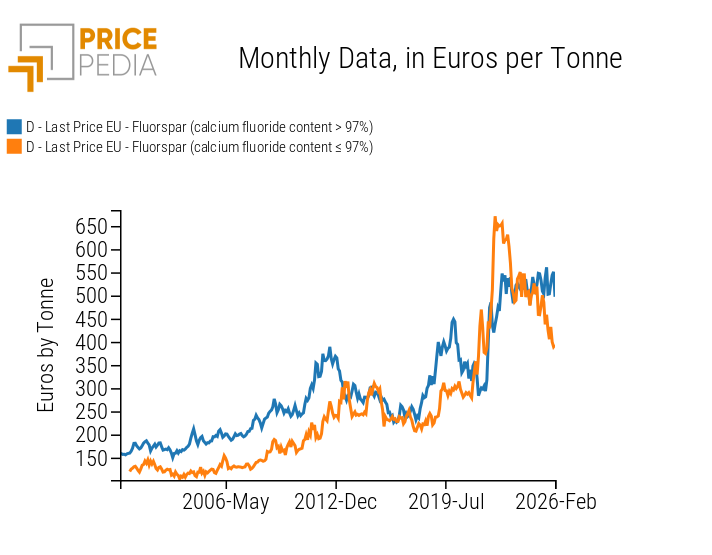
The February 2026 update of PricePedia data shows an EU fluorspar market that is only marginally evolving. As illustrated in the chart below, in the first months of 2026 fluorspar with a calcium fluoride content of 97% continued to trade at elevated price levels, in line with those recorded throughout the second half of 2025.
By contrast, prices for fluorspar with a calcium fluoride content below 97% have declined. However, the significance of this trend is limited by the high heterogeneity of the products included in this category, which differ in calcium fluoride content and therefore in commercial value.
Fluorspar: EU customs prices
High fluorspar prices are adding to the equally elevated prices of sulfuric acid, creating cost pressure on hydrofluoric acid production and keeping HF prices at historically high levels. At the beginning of 2026, intra-EU hydrofluoric acid transaction prices remain above EUR 2300 per tonne, only slightly below the peak reached in 2023 but still approximately 40% higher than in 2019.
As discussed in Fluorine industry: the criticality of fluorsparr, tensions in the EU fluorspar market stem from the European industry’s unsuccessful attempts to diversify sourcing away from Chinese suppliers.
In 2025, the EU market experienced an actual fluorspar shortage, prompting suppliers to place on the market even lower-grade material with reduced calcium fluoride content.
The differing intensity of market tensions between Europe and China has resulted in a marked divergence in hydrofluoric acid prices across the two regions, with significant repercussions for all downstream fluorochemical products.
EU vs China: Cost and Price Differentials in Hydrofluoric Acid
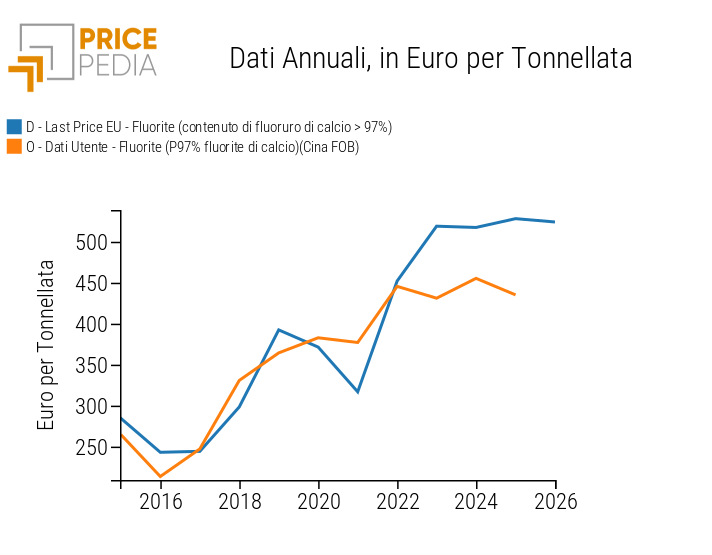
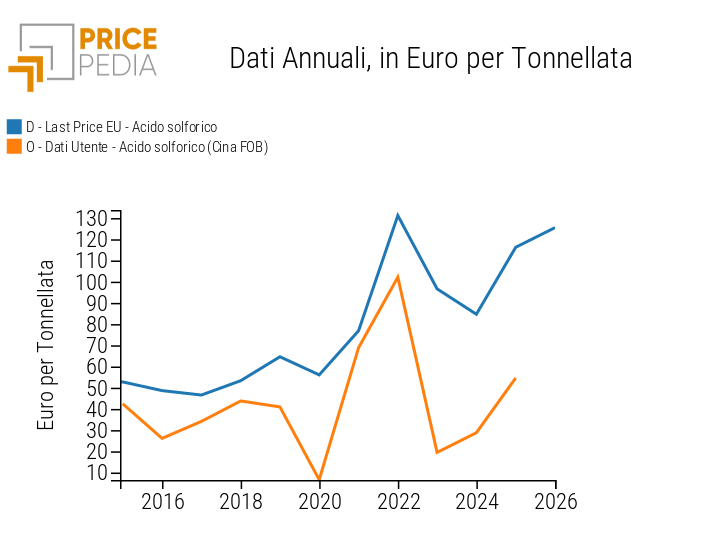
The two charts below compare the main inputs used in hydrofluoric acid production: fluorspar and sulfuric acid. In both cases, a price gap between Europe and China has progressively widened in recent years.
While up to 2022 the difference between the two regions remained relatively limited, in 2025 the differential increased significantly. On average in 2025, the price of fluorspar in intra-EU trade was 25% higher than the FOB price of Chinese exports. The gap was even more pronounced for sulfuric acid, with EU prices exceeding Chinese levels by more than 50%.
Comparison between EU and Chinese prices
| Fluorite | Sulphuric acid |
|---|---|
 |
 |
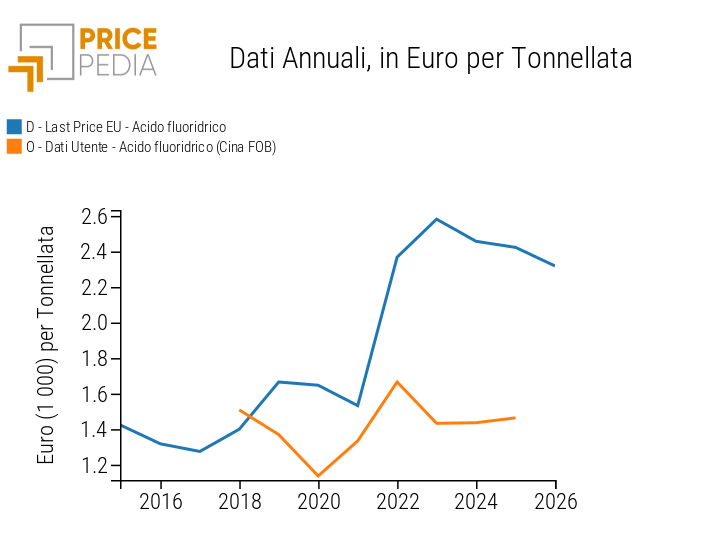
The widening differential in input prices has inevitably translated into a broader gap between EU and Chinese hydrofluoric acid prices. The price of this key chemical feedstock is structurally lower in China than the European average, and in recent years this divergence has further intensified.
In 2025, while the average price in intra-EU trade exceeded EUR 2400 per tonne, the FOB price of Chinese exports remained below EUR 1500 per tonne.
Hydrofluoric acid: comparison between EU and Chinese pricesi
Do you want to stay up-to-date on commodity market trends?
Sign up for PricePedia newsletter: it's free!
Implications for Downstream Derivative Prices
Hydrofluoric acid acts as a true industrial hub from which most fluorine-containing chemical products originate.
The figure below presents a map of the fluorochemical industry, highlighting the production linkages between different products. Each connection is associated with a numerical value representing the price elasticity of the derived compound with respect to changes in the input price. This framework provides an immediate view of the strength of price transmission mechanisms and their economic relevance along the value chain.
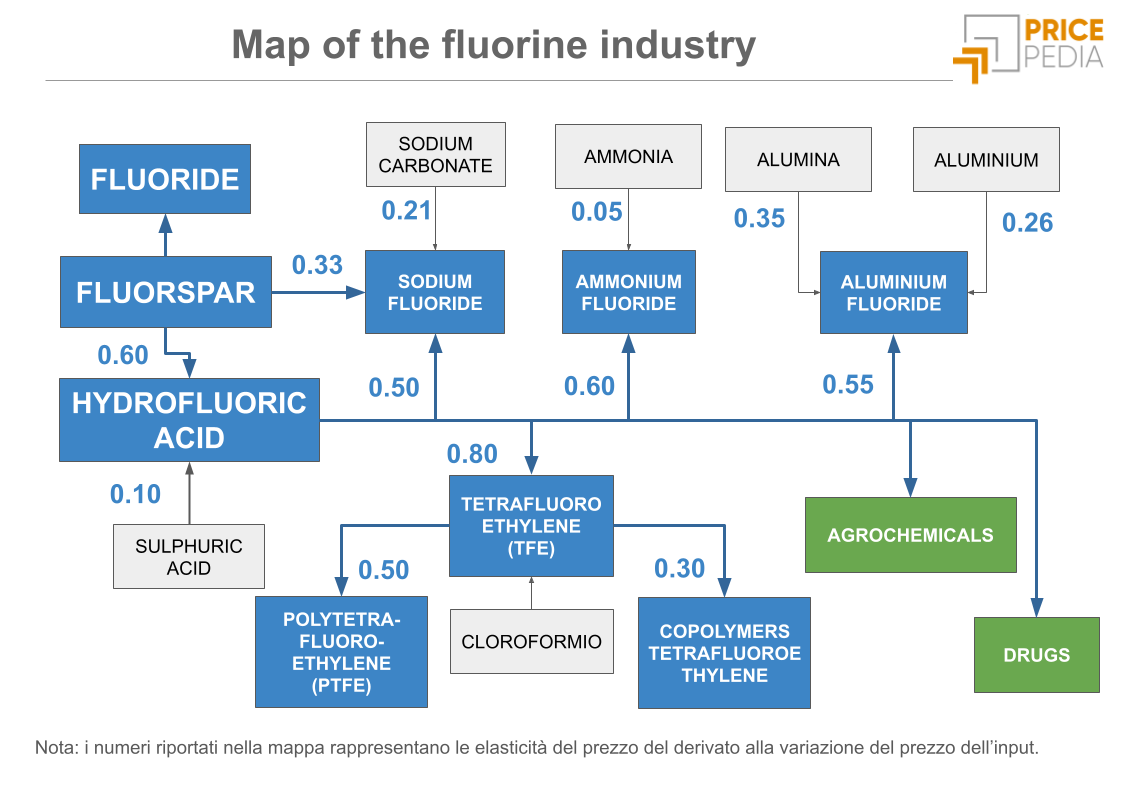
The chemical and physical properties of hydrofluoric acid entail high logistics and handling costs, particularly for transportation and storage. As a result, major production hubs compete only to a limited extent in the international market, allowing significant price differentials to persist across geographical regions. However, as highlighted by the values shown in the map, changes in hydrofluoric acid prices are transmitted to downstream derivatives to a considerable degree, with long-term elasticities ranging between 0.5 and 0.8. In this context, a competitive advantage in hydrofluoric acid pricing tends to translate, at least partially, into a competitive advantage in derivative compounds, which are more exposed to international competition.
The table below reports prices of selected hydrofluoric acid derivatives based on intra-EU trade data and Chinese export prices. The data clearly show that European prices for the various products are significantly higher than their Chinese counterparts. Moreover, this gap has widened in recent years, in line with the growing differential in hydrofluoric acid prices.
Hydrofluoric acid derivatives: comparison between EU and Chinese prices (euro/tonne)
| 2019 | 2020 | 2021 | 2022 | 2023 | 2024 | 2025 | |
|---|---|---|---|---|---|---|---|
| Sodium flouride | |||||||
| intra-EU customs prices | 1656 | 1724 | 1807 | 2327 | 2686 | 2731 | 2642 |
| China FOB export prices | 935 | 891 | 958 | 1293 | 1286 | 1124 | 1033 |
| Ammonium fluoride | |||||||
| intra-EU customs prices | 2024 | 2108 | 2209 | 2845 | 3282 | 3337 | 3229 |
| China FOB export prices | 1409 | 1188 | 1298 | 1631 | 1459 | 1467 | 1395 |
| Aluminium fluoride | |||||||
| intra-EU customs prices | 1413 | 1190 | 1097 | 1559 | 1641 | 1440 | 1575 |
| China FOB export prices | 1332 | 1070 | 1074 | 1440 | 1266 | 1266 | 1339 |
| Polytetrafluoroethylene (PTFE) | |||||||
| intra-EU customs prices | 11657 | 11184 | 11552 | 13995 | 16463 | 15066 | 15108 |
| China FOB export prices | 7669 | 5342 | 7009 | 8848 | 7977 | 7672 | 6517 |
| Tetrafluoroethylene copolymers | |||||||
| intra-EU customs prices | 17505 | 16681 | 16304 | 25392 | 30040 | 26775 | 23040 |
| China FOB export prices | 11402 | 10443 | 13341 | 24978 | 17200 | 13712 | 12096 |
Conclusions
In recent years, the European fluorspar market has been characterized by persistent supply shortages, pushing prices above EUR 500 per tonne. This increase, combined with the simultaneous rise in sulfuric acid prices, has generated significant cost pressure on hydrofluoric acid production.
For more than five years, hydrofluoric acid prices have remained consistently within the range of EUR 2300–2600 per tonne, representing an increase of approximately EUR 1000 compared with the average levels recorded in the previous decade. This marks a structural shift rather than a temporary cyclical fluctuation.
The structural rise in costs has further widened the gap between European and Chinese hydrofluoric acid prices, laying the groundwork for a progressive deterioration in the competitiveness of the European derivatives industry relative to its Chinese counterpart. Unless input cost conditions rebalance or targeted industrial and strategic measures are implemented, the competitive gap is likely to consolidate along the entire fluorochemical value chain.
You may be interested in:
Derivatives of Hydrofluoric Acid
Published by Luigi Bidoia. .
Inorganic Chemicals Fluorine and derivatives Price DriversI prezzi dei Fluoruri inorganici e dei Fluoropolimeri stanno riflettendo gli elevati prezzi dell'acido fluoridrico [ Read all ]

Fluorine industry: the criticality of fluorspar
Published by Luigi Bidoia. .
Inorganic Chemicals Fluorine and derivatives Critical raw materialsThe small number of fluorspar exporting countries keeps prices high for the entire fluorine industry [ Read all ]