Brass and stainless steel in plumbing fittings
Is there a process underway to replace the inputs for plumbing fittings?
Published by Luca Sazzini. .
Stainless Steel Brass Analysis tools and methodologiesIn the plumbing fittings market, the two main production inputs are brass and stainless steel, as both provide adequate mechanical performance, high corrosion resistance, and compliance with the hygienic and sanitary requirements necessary for use in drinking water systems.
Brass has historically been the most used material due to its excellent workability and good corrosion resistance, factors that have favored its use in large-scale production processes.
Stainless steel, on the other hand, is distinguished by its lead-free composition, high durability, and superior resistance under particularly harsh operating conditions, characteristics that make it suitable for high-performance applications or those subject to stricter sanitary requirements.
The chart below shows the evolution of European customs prices for brass and stainless steel bars, in order to compare the production cost trends of the two main materials used in the plumbing fittings sector.
Comparison of European Customs Prices for Brass and Stainless Steel Bars
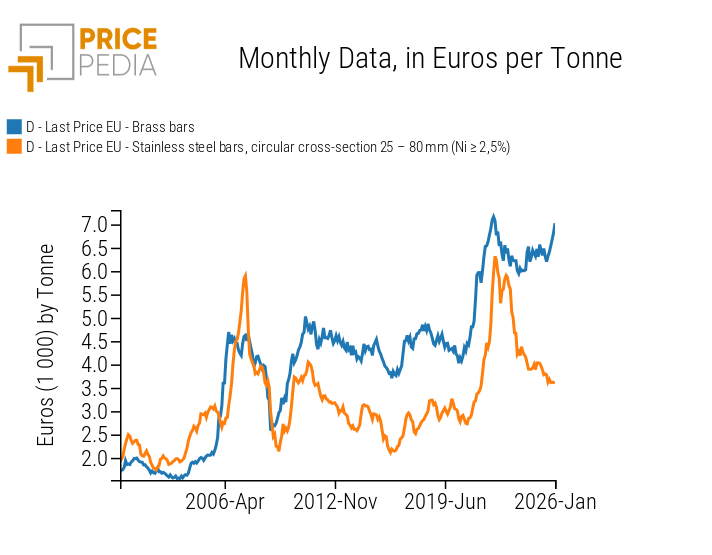
Analysis of the chart shows that, from 2000 to 2008, the price of stainless steel was slightly higher than that of brass. Subsequently, the price of brass surpassed that of stainless steel, before returning to relatively similar levels in 2022, when the average European brass bar price was 6751 EUR/ton and stainless steel bars were 5506 EUR/ton. In essence, for a long period, the price of the two raw materials had a relatively limited influence on the choice of which material to use.
In the last three years, however, the prices of the two metals followed heterogeneous trends: stainless steel experienced a significant decline, while brass remained relatively stable, supported by the sharp increase in copper prices, which reached new historic highs in January 2026, with the LME benchmark monthly average exceeding $13000/ton.
This divergence has created a substantial price gap between brass and stainless steel: in January 2026, the value of brass bars exceeded 7000 EUR/ton, almost double that of stainless steel bars, which were priced at 3600 EUR/ton.
The sharp change in relative prices between the two production inputs may have initiated a substitution process in the plumbing fittings market. In particular, the significant increase in brass prices could encourage greater use of stainless steel fittings due to their higher economic convenience.
To assess the possible presence of a [1] substitution effect at the global level, an analysis of international trade flows for brass and stainless steel fittings is conducted, in order to observe their evolution over recent years.
Analysis of Global Trade Flows
The chart below shows the evolution of international trade in brass and stainless steel fittings, expressed in quantity terms.
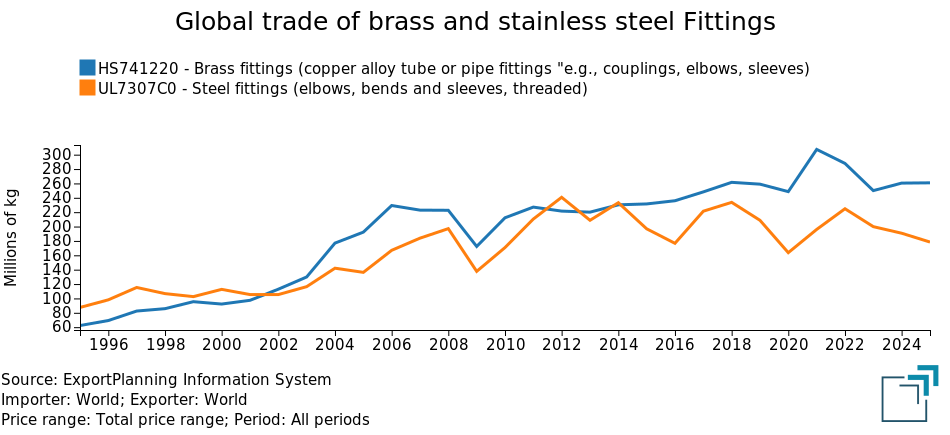
Analysis of global trade flows for brass and stainless steel fittings does not indicate the existence of a substitution process from brass to stainless steel in plumbing applications. In recent years, while the quantities of brass fittings traded have slightly increased, those of stainless steel fittings have actually declined. Therefore, the relative price change does not seem to have been sufficient, at least so far, to promote greater use of stainless steel at the expense of brass.
Where relative prices have not produced effects, the new EU regulations on lead reduction could have an impact. Lead, although present in limited amounts, is necessary in brass to improve its workability; a reduction could therefore diminish the advantages of brass, promoting greater use of stainless steel in the plumbing fittings market.
Do you want to stay up-to-date on commodity market trends?
Sign up for PricePedia newsletter: it's free!
EU Regulations on Lead Limitation
On December 16, 2020, the European Commission published the EU Directive 2020/2184, also known as the Drinking Water Directive (DWD), which establishes new provisions to ensure the safety and quality of drinking water, with direct consequences for materials used in the manufacturing of faucets, valves, and hydraulic components.
Subsequently, in 2024, the delegated acts of the DWD were published, including the Delegated Regulation (EU) 2024/370, which establishes the European positive lists (EUPL), i.e., the official list of alloys authorized for contact with drinking water, and the Implementing Decision (EU) 2024/367, which defines operational procedures for the transition, including exemptions, monitoring procedures, and timelines to ensure uniform application across Member States. Specifically, starting from January 1, 2027, only alloys included in the EUPL may be used for producing components intended for contact with drinking water, except for certain alloys approved by a competent authority in a Member State between 2021 and 2026, which comply with the 5 µg/l lead limit at the point of use; these may continue to be used until December 31, 2032.
The implementation of these regulations will entail a transition to low-lead or lead-free alloys, which require longer processing times and targeted investments in tools and production strategies to compensate for the loss of workability provided by lead. This situation could compromise the current European leadership in the brass fittings market, favoring greater use of stainless steel over brass.
In Summary
In the last three years, the relative price between brass and stainless steel has experienced significant changes: while in 2022 the two main production inputs in the plumbing fittings market had relatively similar price levels, by January 2026 the price of brass had reached roughly double that of stainless steel.
However, this sharp change in relative prices does not appear to have triggered a substitution effect in the plumbing fittings market. Analysis of international trade flows shows that, in recent years, there has been no increase in global trade of stainless steel fittings at the expense of brass; on the contrary, global trade of brass fittings has increased, while that of stainless steel has declined.
If relative prices have so far not led to a shift from brass to stainless steel in the plumbing fittings market, such an effect could instead occur following the new EU safety regulations. The European Union is initiating a transition to low-lead or lead-free alloys, which involve longer processing times and require targeted investments in tools and production strategies to compensate for the loss of workability provided by lead. This change could promote greater use of stainless steel in plumbing fittings at the expense of brass.
[1] In economic literature, a “substitution effect” refers to the change in consumer choices caused by a change in the relative price of a good.
You may be interested in:

Price analysis of semi-finished brass products
Published by Luca Sazzini. .
Brass Price DriversComparison of regional prices of brass bars, sheets, tubes and wires [ Read all ]
Ferritic coils: the cost pass-through of input prices
Published by Luca Sazzini. .
Ferrous Metals Stainless Steel Cost pass-throughPrices of extralega and steel charge have similar effects [ Read all ]
Cost pass-through of hot-rolled austenitic coil prices
Published by Luca Sazzini. .
Ferrous Metals Stainless Steel Cost pass-throughThe importance of extra-alloy AISI 304 in determining the prices of austenitic coils [ Read all ]