Commodity prices amid geopolitical uncertainty and prospects for US tariff revisions
The Supreme Court declares the Trump administration's global tariffs unlawful
Published by Luca Sazzini. .
Conjunctural Indicators Commodities Financial WeekThis week, energy product prices recorded significant increases due to rising tensions between the United States and Iran. President Donald Trump issued an ultimatum to Tehran, threatening possible military action if a nuclear agreement is not reached within 10-15 days. Meanwhile, in the region, U.S. military presence has already increased, while Iran has temporarily restricted traffic through the Strait of Hormuz due to naval military exercises.
In the absence of an agreement, markets anticipate a brief and limited confrontation, with only temporary effects on oil prices. A more prolonged and intense scenario, however, would have much more serious implications for energy markets, increasing risks for Iranian oil infrastructure and, more generally, for the Persian Gulf region.
Elevated risk premiums are also supported by the stalemate in negotiations between Russia and Ukraine and the decline in U.S. stockpiles reported by the Energy Information Administration (EIA).
Nonetheless, the fundamentals of the oil market remain predominantly bearish, with a context still characterized by an oversupply. The Brent futures curve suggests that market participants expect a gradual price decline in the coming months, despite high volatility linked to the uncertain outcome of U.S.–Iran negotiations.
The following chart shows a comparison between the Brent futures curve on February 2 and that on February 20.
Comparison of Brent Futures Curves
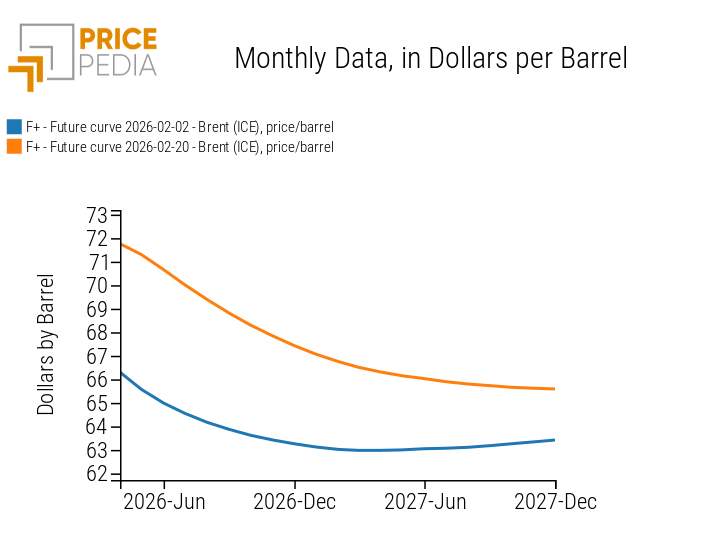
Analysis of the chart shows the evolution of the historical Brent futures curve from the beginning of the month. Following the recent price increase, the market now anticipates a more pronounced decline in quotations, reaching $65.6/ton by December 2027, slightly above the expectations at the beginning of the month, which were $63.4/ton.
In the European natural gas market, the TTF Netherlands price opened the week lower, continuing the downward trend due to milder weather forecasts. However, prices rebounded following the escalation of geopolitical tensions between the United States and Iran, with daily increases of almost 6%.
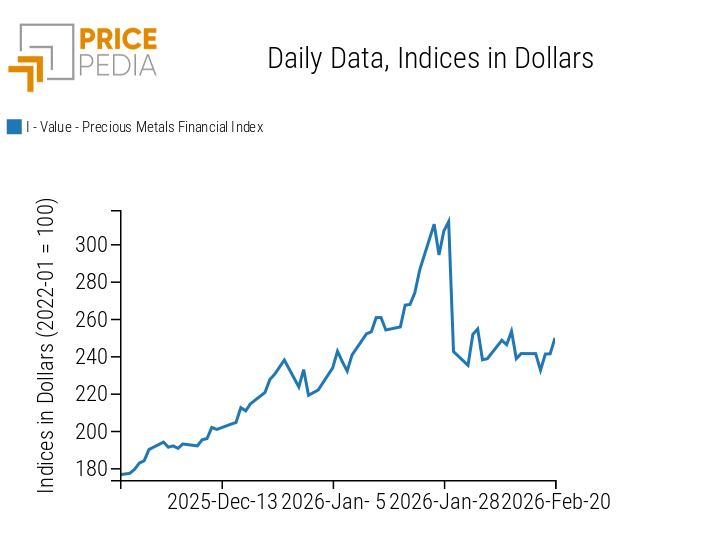
Among precious metals, after early-week declines, prices rose due to escalating geopolitical tensions, with gold and silver returning to approximately $5000/oz and $80/oz, respectively.
The industrial metals sector showed relative stability on major Western exchanges, both for ferrous and non-ferrous metals, while Chinese financial markets remained closed for Lunar New Year celebrations.
Regarding the copper market, recent negotiations between Rio Tinto and Glencore for a potential $260 billion+ merger stalled again, leaving the current market structure unchanged.
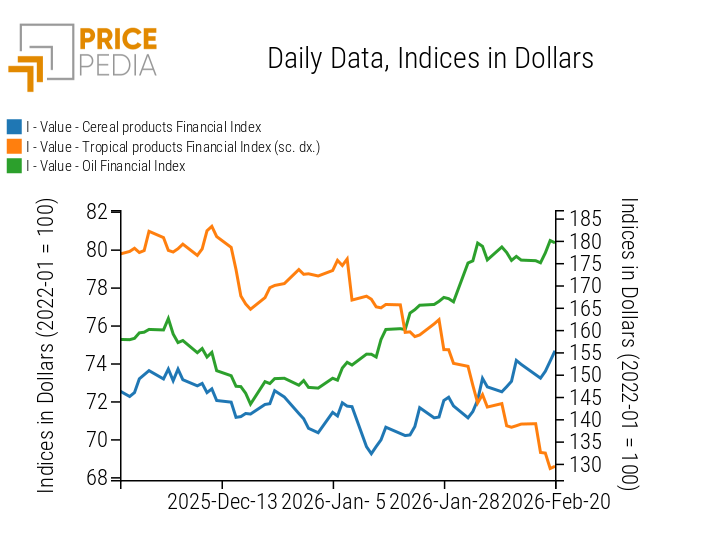
In the food sector, there was a slight increase in edible oil and cereal prices, while tropical commodities continued their downward trend. The sharpest decline continues to affect cocoa, whose prices have fully absorbed the 2024 increases, returning to 2023 levels. Coffee also continues its price reduction phase, amid expectations of increased stocks. Conversely, sugar financial prices rebounded after last week’s decline.
US Duties Declared Illegitimate by the Supreme Court
On February 20, 2026, the United States Supreme Court ruled that several tariffs introduced by the Donald Trump administration were not legally authorized and are therefore deemed illegitimate.
In its reasoning, the Court stated that the President had invoked the International Emergency Economic Powers Act, but that law does not grant the executive branch the power to impose general tariffs on imports from multiple trade partners. The Court reaffirmed that only Congress can authorize the imposition of general tariffs, thereby upholding the principle of separation of powers.
Consequently, global tariffs imposed under the emergency law must be repealed or amended, while other tariffs with different legal bases, such as those on specific sectors or products, remain in force until further challenges or renegotiations.
This decision will significantly impact commodity prices in international markets, affecting trade flows, procurement costs, and market participants’ expectations.
NUMERICAL APPENDIX
ENERGY
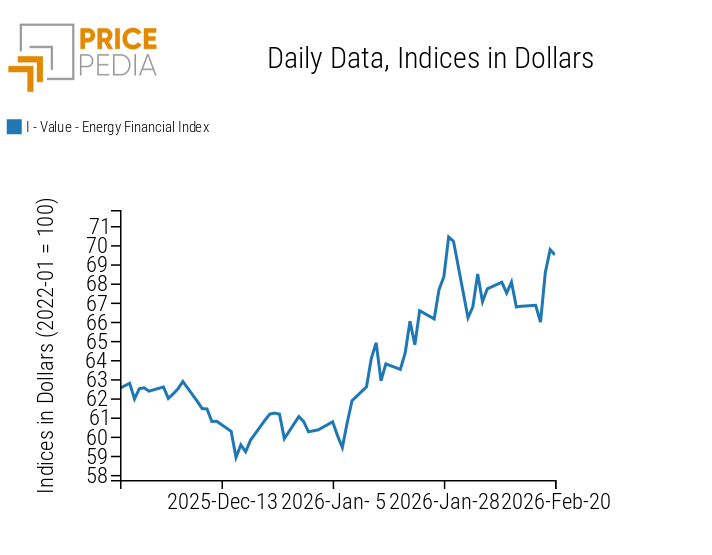
The PricePedia financial index for energy shows rising prices due to escalating geopolitical tensions between the United States and Iran.
PricePedia Financial Index of Energy Prices in USD
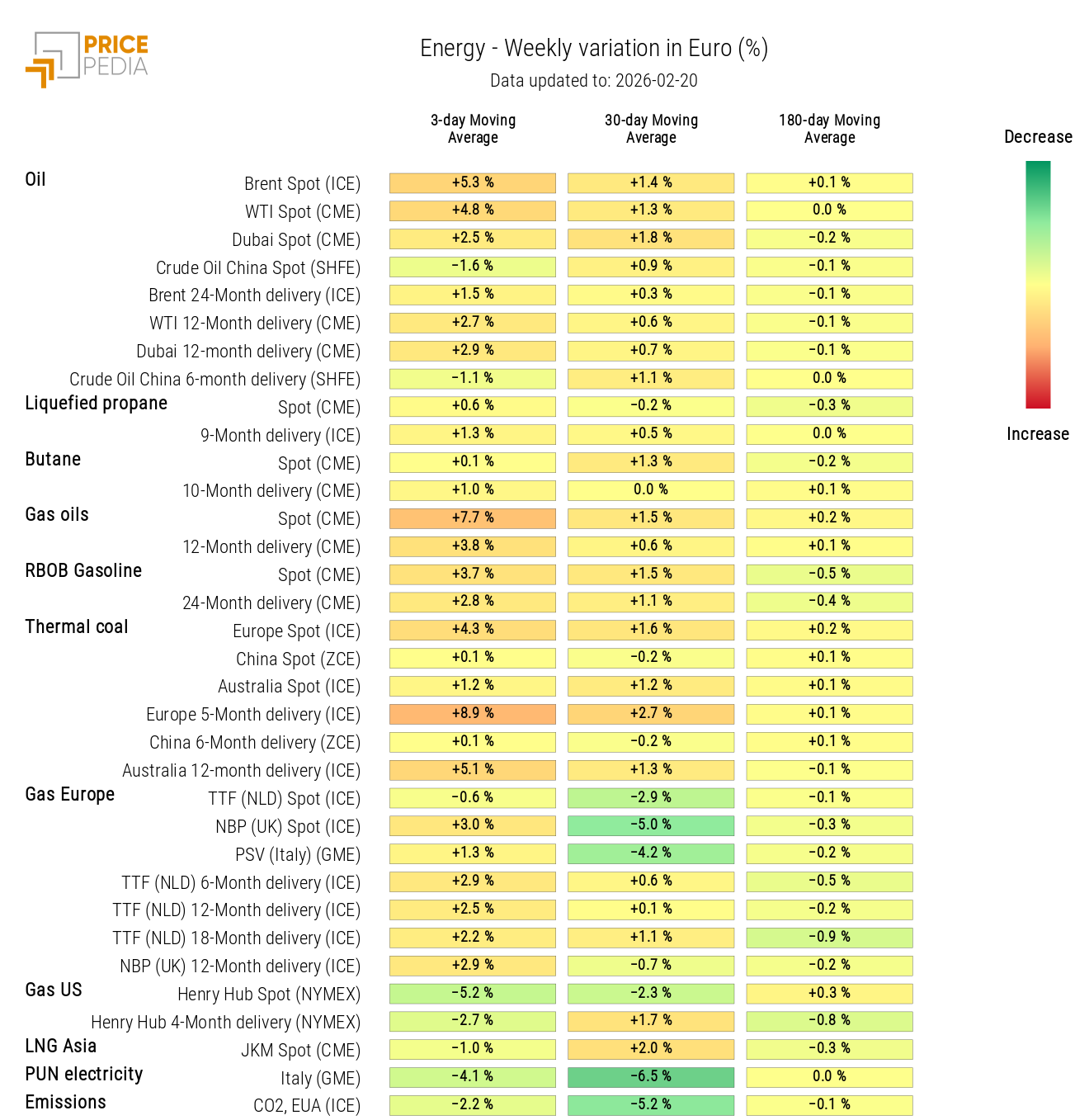
Analysis of the energy heatmap shows price increases in oil and its derivatives.
Energy Prices HeatMap in EURO
PRECIOUS METALS
The financial index for precious metals shows a weekly increase linked to the escalation of geopolitical risks.
PricePedia Financial Index of Precious Metals Prices in USD
FERROUS METALS
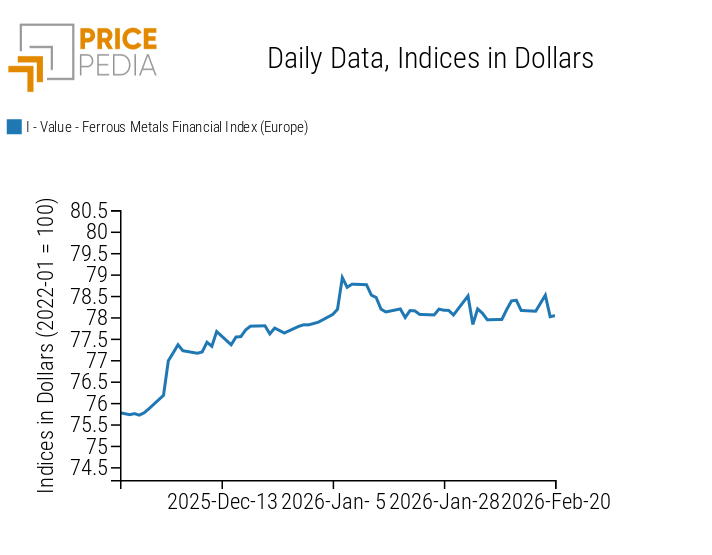
The European ferrous metals index has followed a mostly sideways price trend.
PricePedia Financial Index of Ferrous Metals Prices in USD
Do you want to stay up-to-date on commodity market trends?
Sign up for PricePedia newsletter: it's free!
NON-FERROUS INDUSTRIAL METALS
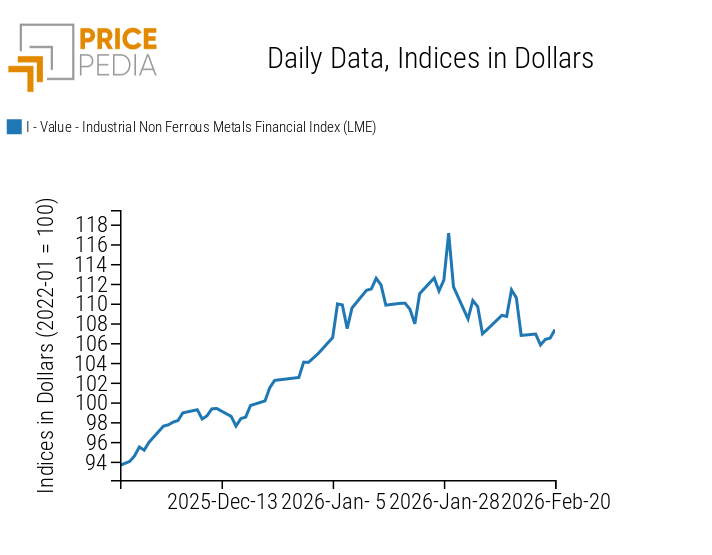
Financial prices of non-ferrous metals traded on the London Metal Exchange show slight fluctuations that do not alter overall price trends.
PricePedia Financial Index of Non-Ferrous Industrial Metals Prices in USD
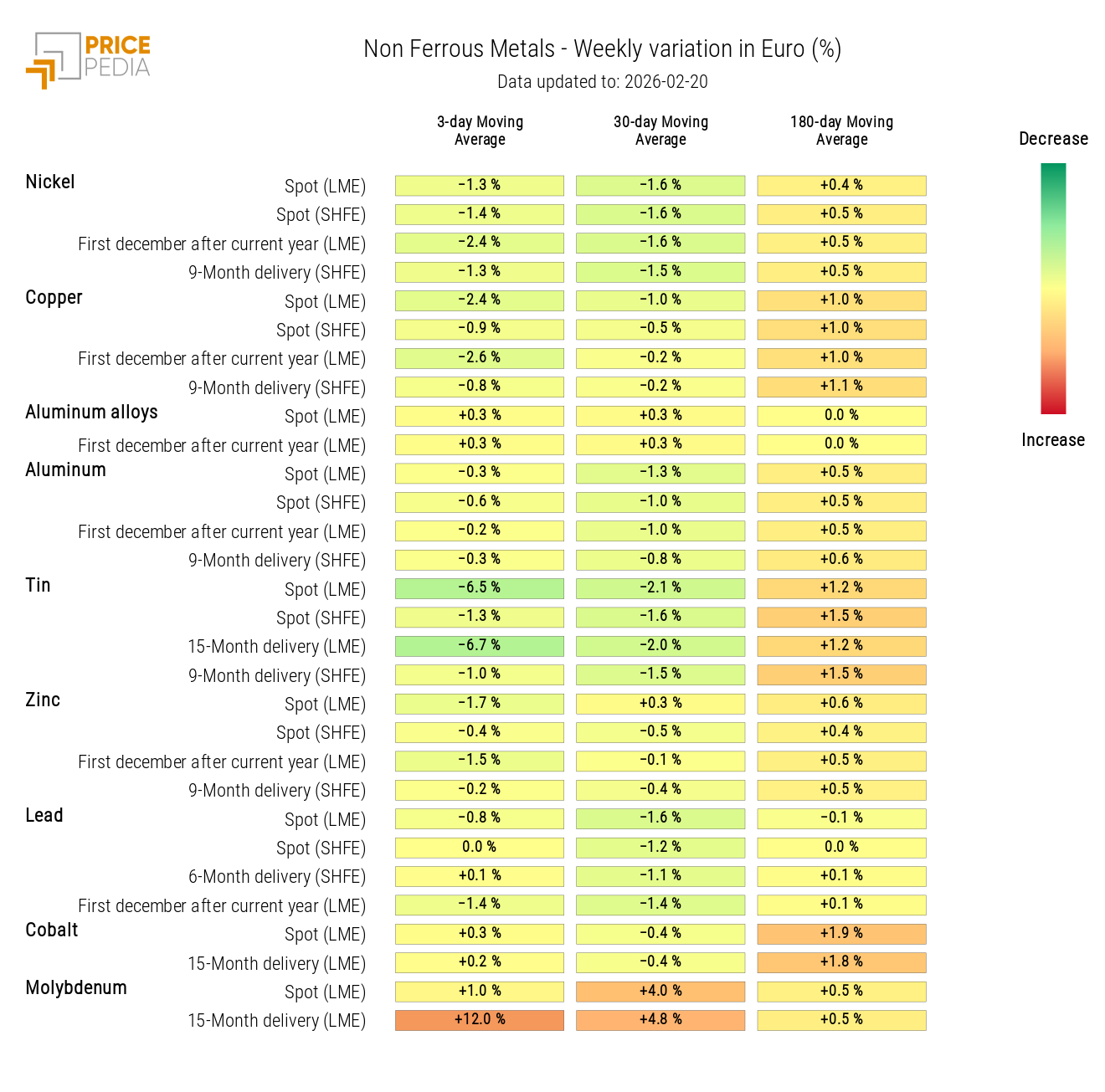
Analysis of the non-ferrous heatmap shows a weekly decline in the 3-day moving average prices of tin, copper, and nickel.
Non-Ferrous Prices HeatMap in EURO
FOOD
Financial indices for edible oils and cereals show weekly increases, while the tropical commodities index continues its price decline.
PricePedia Financial Index of Food Prices in USD
CEREALS
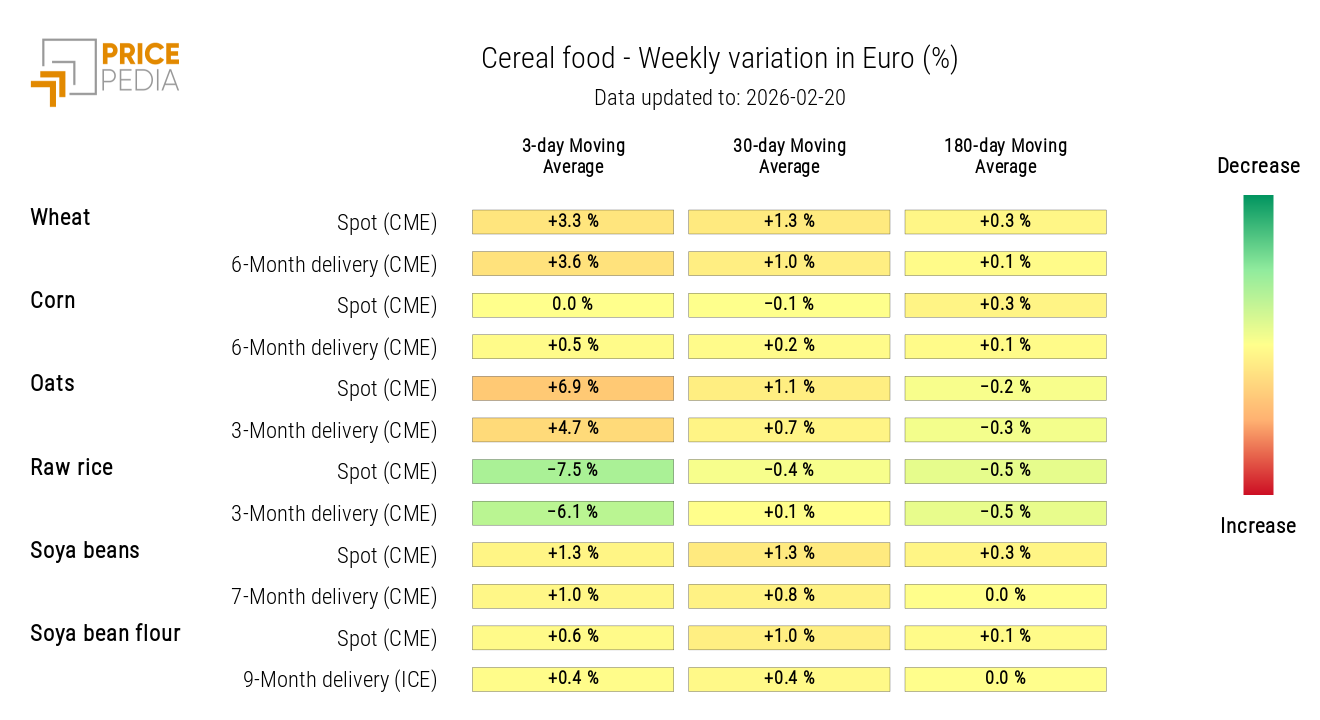
The cereals heatmap shows price increases for oats and wheat, against a significant decline in raw rice prices.
Cereals Prices HeatMap in EURO
TROPICALS
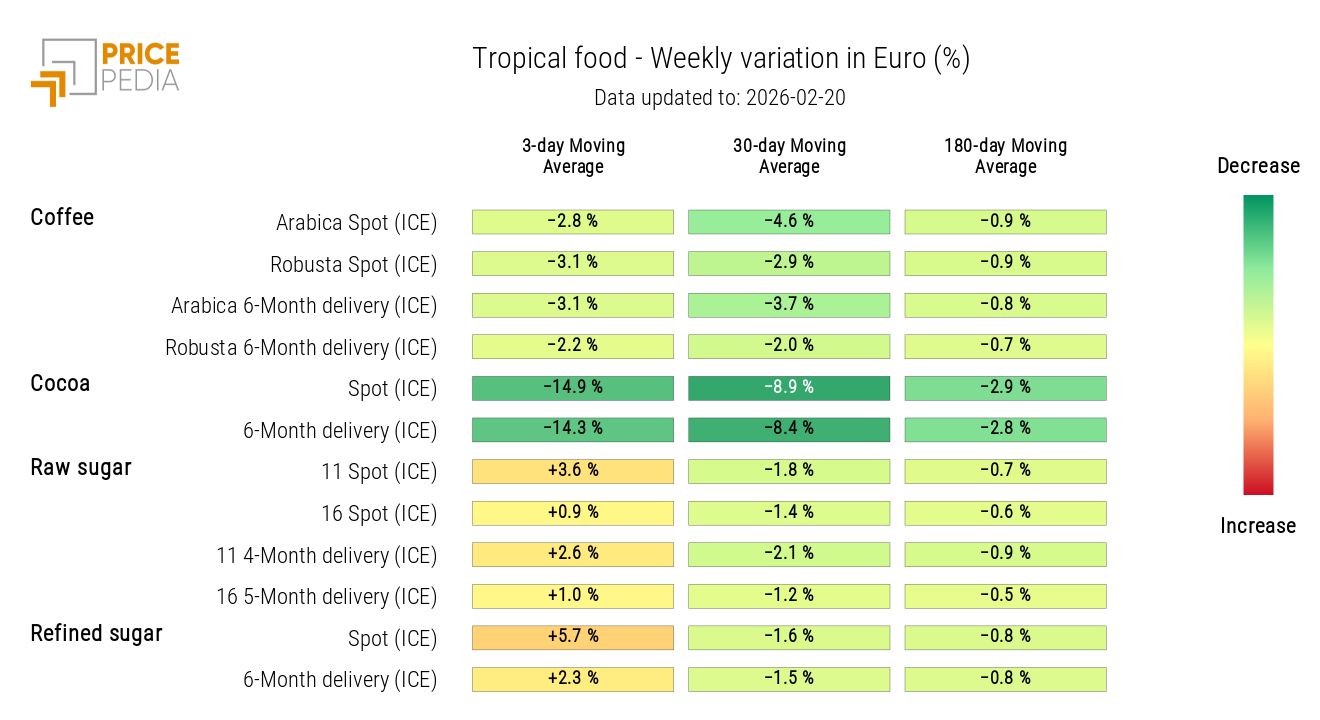
The tropical commodities heatmap highlights a significant drop in cocoa prices, followed by a less marked decline in coffee. Additionally, financial sugar prices rebounded.
Tropical Food Prices HeatMap in EURO
OILS
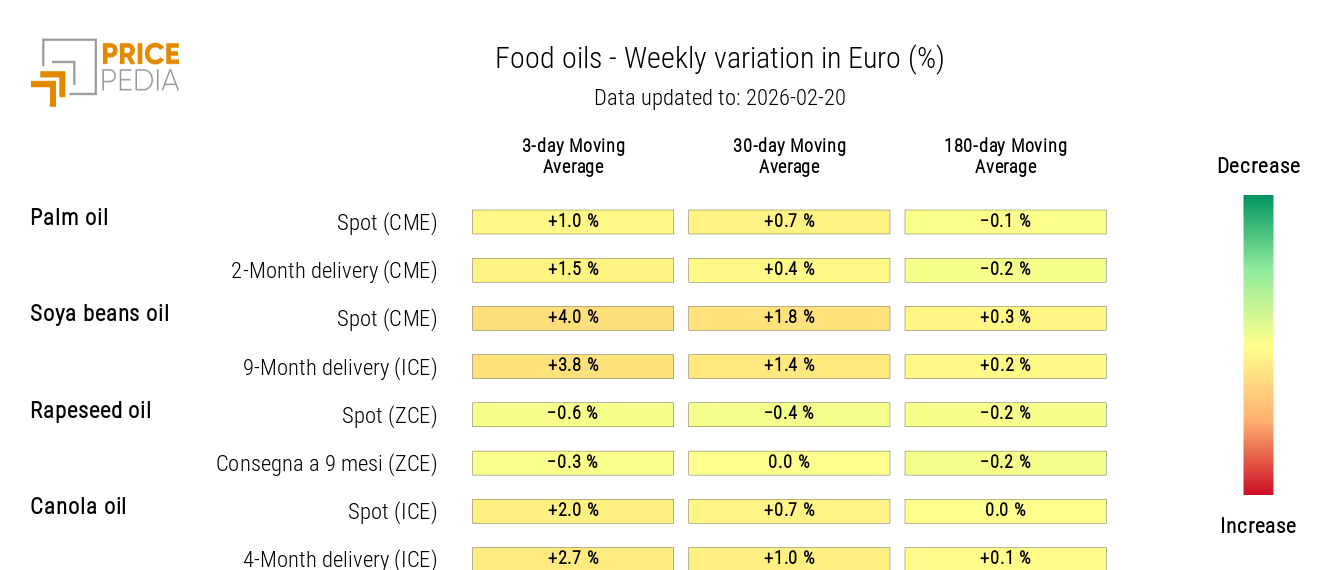
Analysis of the edible oils heatmap shows a rise in soybean oil prices.
Edible Oils Prices HeatMap in EURO
You may be interested in:

Conflict and production disruptions are driving commodity markets
Published by Luca Sazzini. .
Conjunctural Indicators Commodities Financial WeekSupply concerns are driving up industrial metal prices [ Read all ]

China economic update February 2026
Published by Luca Sazzini. .
Conjunctural Indicators Global Economic TrendsWhat price trends can we expect in light of the conflict in the Persian Gulf? [ Read all ]

Commodity volatility accentuated by uncertainty over the outcome of negotiations with Iran
Published by Luca Sazzini. .
Conjunctural Indicators Commodities Financial WeekEU-Australia Trade Agreement: A New Chapter in Free Trade [ Read all ]