How the Italian electricity market has changed over the last 6 years
Consumption and generation mix: the foundations for understanding price developments
Published by Luigi Bidoia. .
Energy cost Electricity's National Single Price Electric Power Energy Transition Price DriversThe Italian electricity market has been hit by a shock of exceptional magnitude during the 2021–2022 period, triggered by the sharp increase in natural gas prices. This shock set in motion a process of structural change in the electricity system, the direction of which is now becoming increasingly clear. This article analyses the impacts on consumption volumes and on the generation mix[1], while the analysis of the effects on electricity prices across the different stages of the value chain, from generation to distribution, is deferred to a subsequent article.
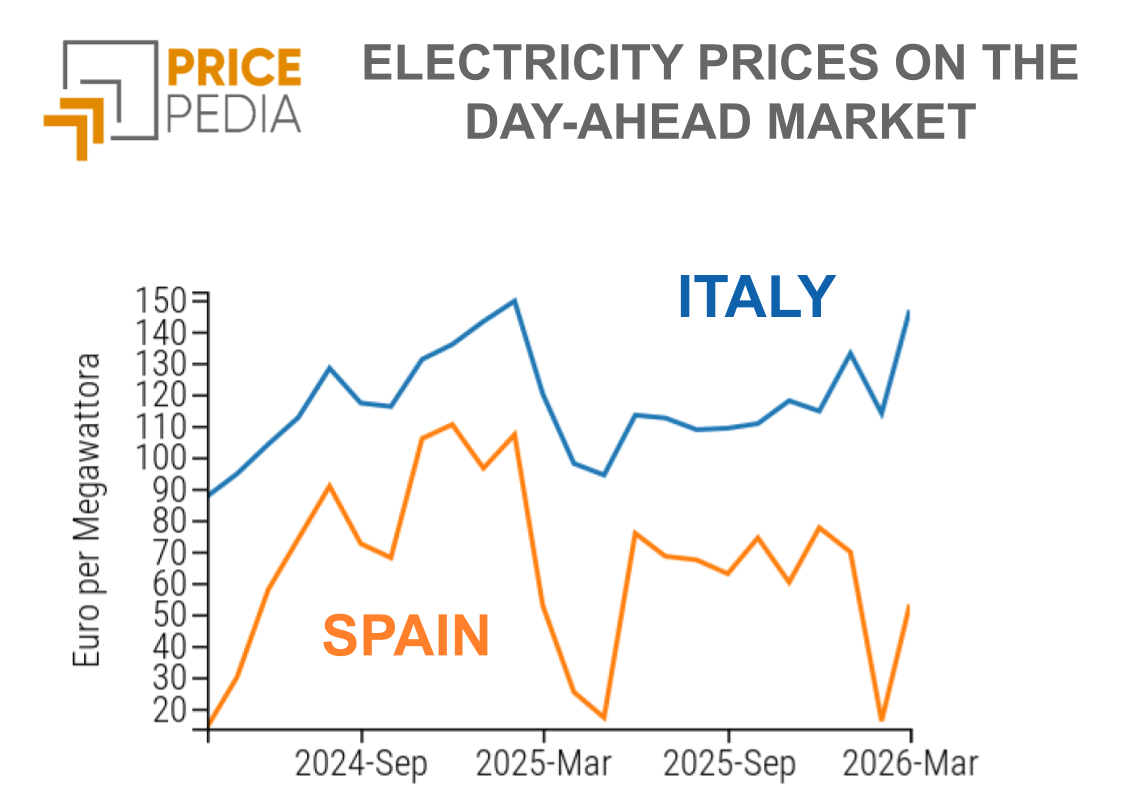
The surge in gas prices in 2021–2022 led to a marked increase in both actual and expected electricity prices, with significant repercussions on both the demand and supply sides of the market. The table below reports electricity consumption, expressed in terawatt-hours (TWh), by type of user, together with electricity generation by source.
Electricity consumption and generation in Italy (TWh)
| 2019 | 2022 | 2024 | 2025 | Var% 2025/2019 | |
| Consumption | |||||
| Manufacturing industry | 114.4 | 114.8 | 109.2 | 106.7 | -6.8 |
| Other sectors | 121.8 | 116.5 | 118.0 | 118.5 | -2.7 |
| Households | 65.6 | 64.5 | 65.4 | 65.7 | 0.2 |
| Total consumption | 301.8 | 295.9 | 292.7 | 290.8 | -3.6 |
| Generation | |||||
| Thermoelectric | 162.8 | 167.2 | 123.4 | 130.3 | -19.9 |
| Renewables | |||||
| Hydroelectric | 47.2 | 29.6 | 52.9 | 41.9 | -11.3 |
| Photovoltaic | 18.6 | 21.4 | 27.3 | 34.0 | 82.7 |
| Wind | 20.0 | 20.3 | 22.0 | 21.2 | 6.0 |
| Geothermal | 5.7 | 5.4 | 5.3 | 5.2 | -7.8 |
| Total renewables | 91.5 | 76.8 | 107.6 | 102.3 | 11.9 |
An analysis of these data highlights a number of key points:
- Contraction in electricity consumption. The increase in electricity prices resulted in a decline in overall consumption, particularly pronounced in the manufacturing sector. Industrial electricity consumption fell from 114.4 TWh in 2019 to 106.7 TWh in 2025, corresponding to a cumulative reduction of 6.8% over six years. This decline is widespread across all industrial sectors, with more pronounced decreases in energy-intensive industries. This trend reflects both lower activity levels in production processes with high electricity intensity and a general improvement in energy efficiency across industry. A significant reduction (-2.7%) is also observed in electricity consumption by non-manufacturing firms. By contrast, household electricity consumption has remained broadly stable, thanks to the adoption of energy-saving solutions that have offset new and increased uses of electricity.
- Evolution of the generation mix. Alongside the contraction in consumption, the electricity generation mix has undergone a profound transformation. Output from thermoelectric power plants declined significantly, from 162.8 TWh in 2019 to 130.3 TWh in 2025, a reduction of 19.9%. Against the backdrop of lower thermoelectric generation, electricity production from photovoltaic sources expanded sharply, reaching 34 TWh in 2025, with growth of more than 80% over six years.
- Production of Renewable Energy Sources (RES) The increase in electricity generation from renewable sources was particularly strong over the 2022–2024 period, while in 2025 there was a decrease. Against a backdrop of a structurally rising trend in photovoltaic generation, the source that continues to play a dominant role in shaping the overall share of renewable electricity production is hydropower, which is subject to significant uncertainty due to variations in precipitation both within the year and across different years. In particular, hydropower generation was exceptionally low in 2022, making a sharp increase in thermoelectric generation necessary.
Do you want to stay up-to-date on commodity market trends?
Sign up for PricePedia newsletter: it's free!
Conclusions
The shock to electricity prices triggered by the 2021–2022 gas crisis set in motion a process of transformation in the Italian electricity market, characterised by a stronger focus on efficiency in electricity consumption and by a gradual reduction in the role of gas-fired thermoelectric power plants in favour of electricity generation from renewable sources, particularly photovoltaic.
Despite its rapid growth, photovoltaic generation remains smaller in scale than hydroelectric production. The continued prominence of hydropower, whose output is strongly influenced by seasonal and interannual variability in precipitation, makes it more complex to identify the structural effects of renewable energy sources on wholesale electricity prices, especially over time horizons longer than daily, hourly or intraday intervals.
[1] The data presented in this article are PricePedia calculations based on data published by Terna's Download Centre
You may be interested in:
How Renewables Reduce the PUN’s Dependence on Gas Prices
Published by Luigi Bidoia. .
Electricity's National Single Price Electric Power Price DriversUna stima econometrica delle determinanti del PUN consente di misurare il contributo dei diversi fattori [ Read all ]
The impact of renewables on the PUN remains limited in the long run
Published by Luigi Bidoia. .
Electricity's National Single Price Electric Power Price DriversSono ancora poche le ore in cui le fonti rinnovabili determinano il prezzo [ Read all ]
PUN price: neither inverse decoupling nor a CO2 effect
Published by Luigi Bidoia. .
Electricity's National Single Price Electric Power Analysis tools and methodologiesLa quota di produzione da fonti rinnovabili spiega in larga misura il recente aumento del prezzo dell’energia elettrica. [ Read all ]